Wednesday January 21, 2026: Maximum Shelf: Catching Sight
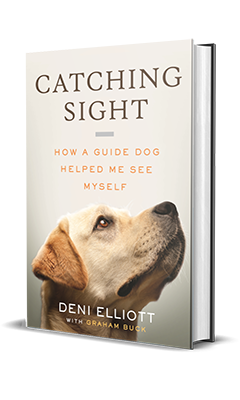
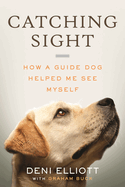
Catching Sight: How a Guide Dog Helped Me See Myself
by Deni Elliott with Graham Buck
When she was diagnosed as legally blind, Deni Elliott was a philosophy professor at the University of Montana, and director of the campus-wide ethics center. Suddenly, she faced an ethical quandary of her own: She'd gotten by as fully sighted, working hard since childhood to conceal her low vison, yet now felt obligated to disclose her disability. As she adjusted to a new life of social workers and adaptive equipment, she wondered if her lifelong love of dogs could be a boon. Indeed, service dogs would become her salvation--but there was to be a steep learning curve before she was matched with the right animal. In her detailed, engrossing memoir, Catching Sight, Elliott explores her special relationships with five very different dogs and explores the process of training guide dogs for this vital duty.
Elliott was born a month premature in 1953 and the highly concentrated oxygen in the incubator damaged her vision. Her parents and older sister, Debbie, always encouraged her to be independent and develop workarounds such that she was mostly able to pass as a sighted person. For instance, her mother and sister taught her to visualize the alphabet via blocks with embossed letters, while her father showed her how to identify coins by their feel in the hand. She also had the comfort of her giant childhood dog, Marty the Newfoundland, who was truly one of the family. They were so close that, when Marty passed, a tearful Elliott told a concerned nun at her school that her big brother had died.
As a successful academic, Elliott was adept at interpreting text on screens, had a graduate student on hand to help with Excel spreadsheets, and could navigate the campus and even her driving route to work so long as she kept to careful routines and took clues from light, color, and shapes within her usual three-foot field of view. "I considered my ability to function with my limited vision as well as those with clear sight a point of personal pride and amusement," she writes.
All this changed with the diagnosis of blindness. It was both a psychological and a practical adjustment: Elliott felt patronized by the state social worker who came to assess her setup (and offered technology incompatible with her Mac computer). She'd been functioning perfectly well, she thought, and resented that now there would be physical signs of her partial sightedness for others to judge her by.
Soon, she was eager to trade her white cane for a guide dog--and had a novel idea of how to do it. Oriel, her devoted golden retriever puppy, moved into the role of assistance dog after just three months of informal training. Oriel accompanied Elliott to campus and, for work purposes, on regular plane commutes to California and Florida. However, her bad habit of stealing food couldn't be broken, and she got burned out by two years of intensive travel. In the end, Oriel retired to a homeless shelter to serve as a therapy dog.
A new strategy was needed. Elliott's first proper guide dog was Wylie the German shepherd, but his temperament wasn't suitable. Energetic and aggressive, he never lost the prey drive for chasing. When he killed a cat, it spelled the official end of his service. Elliott faced further upheaval during these years: her husband, Paul, who was also an academic with long-distance commutes, had an affair and their marriage ended in divorce.
If there's a hero in this book, it's the character who enters next: Alberta the yellow Labrador, "whose quiet and subtle brilliance will capture your heart," as Beacon Press's associate editorial director, Joanna Green, predicts. Alberta went through Graham Buck's accelerated training program for Guiding Eyes for the Blind. Essentially, dogs are chosen before birth, through genetics research and breeding indexes. They live with foster families and undergo a rigorous two-year regime to prepare them for negotiating traffic and dealing with obstacles. When Elliott joined Alberta on Buck's course, she was impressed that the dogs adapted to a rigid feeding and toileting schedule. Alberta's nonverbal communication was astonishing. One day she stopped still on the sidewalk. Elliott had no idea why, then noticed a snake slithering off ahead of them. This was a dog she could trust with her life.
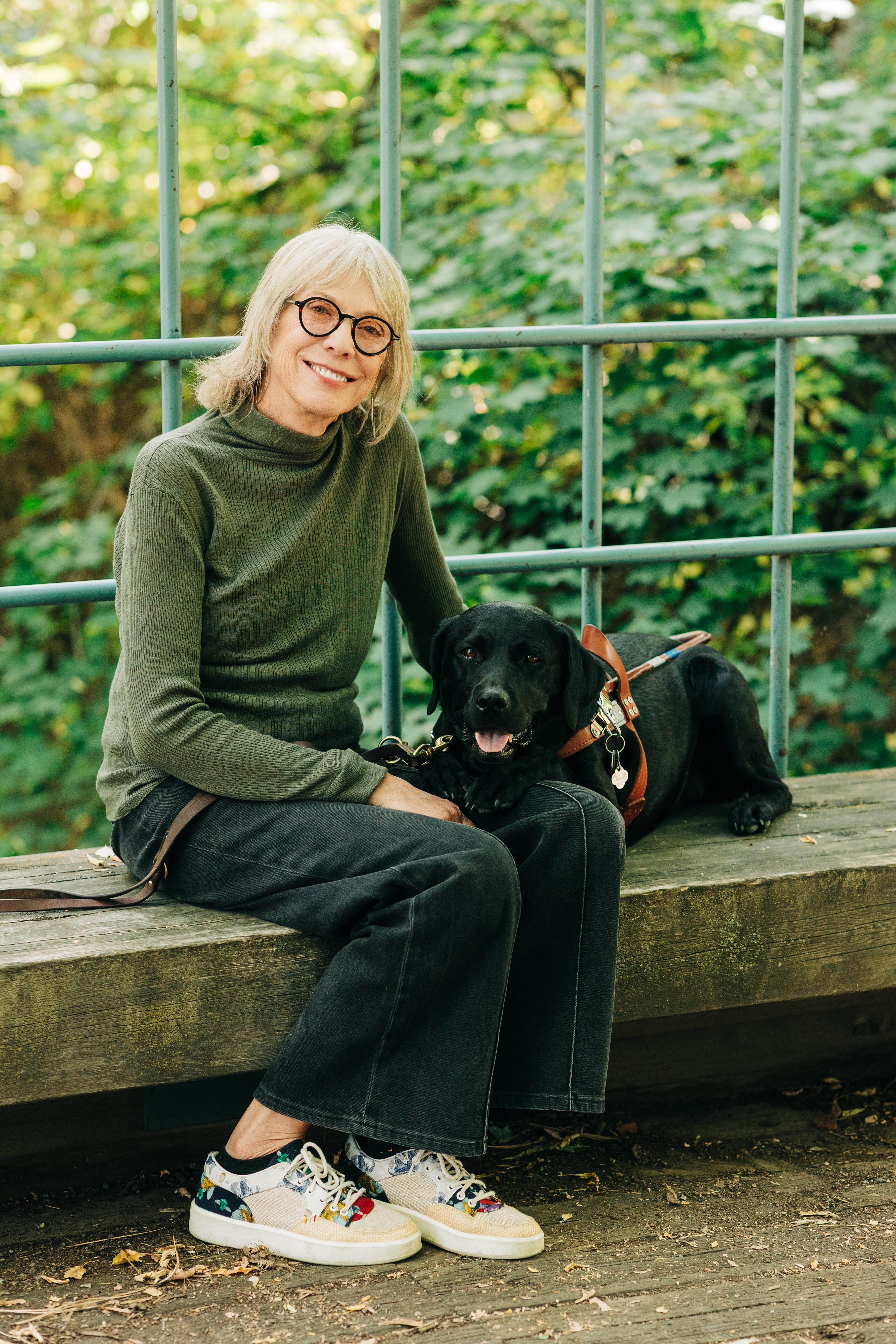
Animal lovers will recognize the joys and heartaches of interdependency. Alberta had real drive and love for her guiding work. Ironically, though, she developed vision problems--a uveal melanoma that required removal of the right eye--that forced her into early retirement. "That dog was one of a kind," Elliott concludes. Alberta leaving her was a blow, but Elliott was then matched with Koala, a female black Labrador who keeps teaching her owner things, and surprising her with her intelligence and initiative.
Catching Sight will reward the curious reader with fascinating accounts of dog training and the adaptations involved in coping with disability. But best of all, it's a heartwarming story of human-animal connection and resilience. --Rebecca Foster
Beacon Press,
$30,
hardcover, 288p., 9780807022542,
June 16, 2026
Catching Sight: How a Guide Dog Helped Me See Myself
by
Deni Elliott with Graham Buck
Deni Elliott is co-director for the National Ethics Project and professor emerita in the Department of Journalism and Digital Communication at the University of South Florida. She is the author or editor of 10 previous books on ethics. Elliott served on the Guiding Eyes for the Blind Graduate Council and co-chaired the nation's first continuing education seminar for guide dog partners. Catching Sight: How a Guide Dog Helped Me See Myself (Beacon Press, June 16, 2026) draws on her experience with impaired vision and the guide dogs who have been in her life.
You managed to get by as a fully sighted person into your 40s. Why did you resist the "disabled" label? If you could counsel your younger self about how to approach your partial sightedness, what would you say?
I have had limited vision from infancy. Over time, I grew into an awareness that what I could see was different from what most other people could see. Concurrently, I believed that I should be quiet about my limitations. My best vision throughout my life has been reading text close to my face. From an early age, I depended on books to help me understand the world around me.
I didn't think of myself as disabled until I accepted that my visual loss was progressive and I was never going to have normal vision. It just didn't occur to me that the "visually impaired" descriptor applied to me before I was in my 30s and 40s. Until then, I always expected my vision to get better.
I wish that as a child I had thought to talk to other people about what they could see. I didn't have my first conversations about visual experience until I went to Guiding Eyes. Eye doctors never asked me to describe what I could see. They did not ask how visual impairment limited my functionality or about tools that might help with that. They talked technically about my visual limitations but not about what it meant for my real life. I see that as a fundamental flaw in the education of optic professionals.
There's an impressive level of detail in this account. How did you go about re-creating everything?
I write to make sense of my life. I have stacks of notes for books that may never get beyond the proposal stage. I need to credit my mother with my ability to re-create scenes from childhood for Catching Sight. She and I were always close and grew closer through my adult years. After my mom read some of the columns I had written about Alberta--based on journaling during my time at Guiding Eyes--my mom said I needed to write this book. From Spring 2013, when I met Alberta, to my mom's death in February 2018, she and I talked in depth about my life, her life and forthcoming death, and the book.
I was also close with my sister Debbie; until her death in October 2014, she and I discussed our memories from childhood. Again, the story we re-created brought mutual understanding and peace.
You can find a collection of my dog blogs from 2012 onward on my website.
How did your academic career in the field of ethics prepare you--and/or complicate matters--as you faced the challenges of disability adjustments, divorce, and training with multiple dogs?
What first attracted me to ethics as a profession is that ethical questions matter because no one ever gets the right answer. There are always more facts that, if known, would alter our reasoned conclusions. Ethical reasoning provides the opportunity to admit and learn from mistakes, and processes for thinking through one's choices.
I am open to experiences that change my beliefs while trying to hold on to some basic values: (1) Know that your choices have power over others; (2) Be clear about your responsibilities and know when you might be justified in not meeting those; (3) Identify and favor the most vulnerable beings in your decision-making; and (4) Be aware of what might be the ethically ideal action, even if you ultimately choose to act in ways that are only ethically permitted. Sometimes I fail.
How would you characterize the relationship with a guide dog?
I'm not sure any pet owner relationship is ever simple. Guide dog partnerships are not employee-employer relationships. I see human and canine as interdependent. The dog is dependent on their human partner for food, shelter, exercise, playtime, and connection. The human is dependent on their canine partner to keep them safe and share their superior sensory abilities such as hearing and smell, in addition to sight. Both dog and person are dependent upon one another for clear communication.
You've had different experiences with guide dogs of varying breeds and temperaments. Have you concluded anything about the ideal guide dog, or is it really down to personality?
Having multiple guide dogs in one's life is easiest if you are, by nature, a serial monogamist. Every canine partner is different because each is an individual. The magic you create with one is different from what you created in the past with a different dog. The one distinction I would make among my guide dogs is that those who are professionally bred and trained get the big picture--I am the eyes for the person who is holding my harness--as opposed to those privately trained to perform guide dog tasks. Oriel and, to a lesser extent, Wylie learned how to perform certain tasks that mitigated my disability. A dog learning how to walk in harness around obstacles and stop at elevation changes is different in kind from a dog learning that their job is to keep their person safe.
People sometimes asked you rude or intrusive questions or distracted your guide dogs while they were working. What are some simple tips for proper etiquette when encountering people with disabilities and service animals?
The public's confusion about service dogs in the United States is understandable: U.S. federal agencies have been inconsistent with one another and less than clear in their messaging. I don't think any other nation determines disability access on the honor system. The person claiming to be disabled and seeking access for their claimed guide dog is not required to show proof of the dog's vaccinations or health status. This is a threat to public safety as dogs can transmit a variety of diseases and parasites. Nor is the person required to show proof that the dog can function in public settings without physically threatening people.
Simple tips for etiquette around service dogs? (1) Ignore the dog. Dogs can't work if others are intentionally distracting them. (2) If you see a purported service dog acting inappropriately, report that to the gatekeeper (business owner or manager, for example); and (3) If you are a gatekeeper, ask people who walk into your "no pet" space the two questions allowed under federal law: Is that a service dog required because of your disability? What tasks has the dog been trained to perform? If the person answers that this is their "emotional support" or "therapy" dog, politely tell them that is not included in the Department of Justice definition of a service dog. --Rebecca Foster