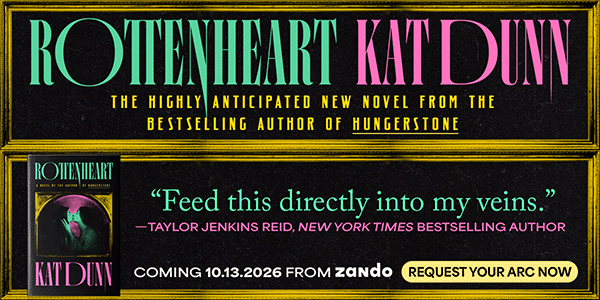
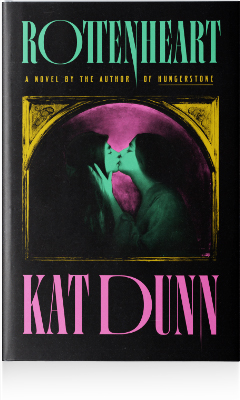
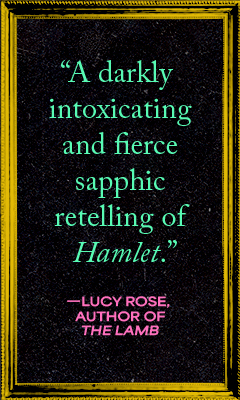
Kat Dunn, author of Hungerstone, ambitiously reimagines Shakespeare's Hamlet in Rottenheart, a gender-swapping, sapphic, Victorian gothic. Shakespeare interpretations are a pervasive part of culture the world over, with each new retelling scrutinized more than the one before. Does that make writing any such novel a daunting, ambitious task? Certainly. Can that novel be all the more impactful when it successfully makes the enduring work of the Bard relatable to a modern reader through a changed setting and complicated relationships? Undeniably. And Rottenheart succeeds admirably.
In atmospheric, evocative prose, Dunn's novel begins at the "time of night when only the dead are abroad" in the Suffolk summer of 1898. With a "tap-tap-tapping like bare feet scurrying across the floor," Odette's mother, Lydia, crawls into her bed as the clock strikes three, where she begs a promise from her daughter: to never leave. The story splits, alternating between a current timeline after Lydia's death and the preceding months during which Odette and her great love and best friend, Cecilia, stand on the cusp of the great changes that await them in adulthood.
The pair has spent many summers at Odette's family's country home and live across the street from one another--secretly clambering in and out of windows late in the evening as their intense, obsessive love deepens. Cecilia, her mother, Penelope, and her brother, Leo, live in the shadow of Odette's well-to-do family, benefiting from Penelope's close friendship with Odette's mother, Lydia--a talented artist susceptible to agitation and melodrama. As they grow up, posing for Lydia's paintings and dreaming of the future, Odette and Cecilia spiral into an ever-more-insular, two-member orbit. Odette often chafes under the weight of her mother's gaze, struggling with Lydia's unreliable whims and demands as she wrestles with having "one part urgent in the need for some aspect of herself that her mother does not know, another in anguish to lose a moment of her attention. Her mother's eye is always wandering towards her own pain, and it would be all too easy to lose her entirely. The question is: which can she bear? The loss of self, or the loss of her mother?"
The answer takes an unexpected form with the arrival of Aunt Claudine, Lydia's estranged sister, who seems determined to take over house and home--including Odette's father, George. Lydia falls ill after Claudine's arrival, rapidly deteriorating before ultimately succumbing to her illness. Odette is suddenly thrust "through a door that she did not know was there" into a "bleak, sharp reality, ugly and ill-formed and discordant." But that reality begins to shift with another "tap-tap-tap" in the night and the appearance of a ghostly apparition, croaking the name "Claudine" as it grabs Odette around the throat. She "flinches away, but her view is filled by her mother's corpse-face, twisted in an inhuman snarl. 'Revenge me. For I am murdered.' "
As the broader cast of characters watches Odette fall into what they deem madness, long-held secrets and lies begin to peek through, driving wedges between Odette and Cecilia, Cecilia and Penelope, Odette and her father--building to a tense, emotional, and messy end.
While there is ample emotional heft to the plot points that lead up to the place at which Lydia's ghost appears, it's after the first haunting that Dunn begins inviting readers into the complex core of Rottenheart. Her exploration of madness considers how little suffering a society is willing to tolerate before deeming it a performative act; she also captures the beauty and harm of a claustrophobic, symbiotic relationship. In all, Dunn offers a skillful rumination on the experience of having one's world and ability to identify and rely on truth entirely uprooted.
Like its source material, Rottenheart is about torment and grief, and the questionable decisions that those ordeals can spur. It asks readers to reconsider their judgments about the expression of the deep feelings of adolescence and young adulthood, and to remember how seismic a first love and a great loss can be. The novel is at its best when it refuses to shy away from the messy complexities of close relationships and the difficult task of holding multiple truths about oneself and each other. "It is too confusing, these feelings of love and revulsion co-mingled within her. How is it possible to love and to hate the same person so completely?" Dunn nimbly captures the lack of a simple answer to these large questions through Cecilia's eyes as Odette begins her freefall: "She cannot make this better. She cannot make this right. All she can do is bear witness and not look away." This reworking of one of Shakespeare’s most well-known plays demonstrates an exemplary balance between hallmarks of the original and an allure that stands all on its own. --Kristen Coates
Zando,
$28.95,
hardcover, 320p., 9781638934653,
October 13, 2026
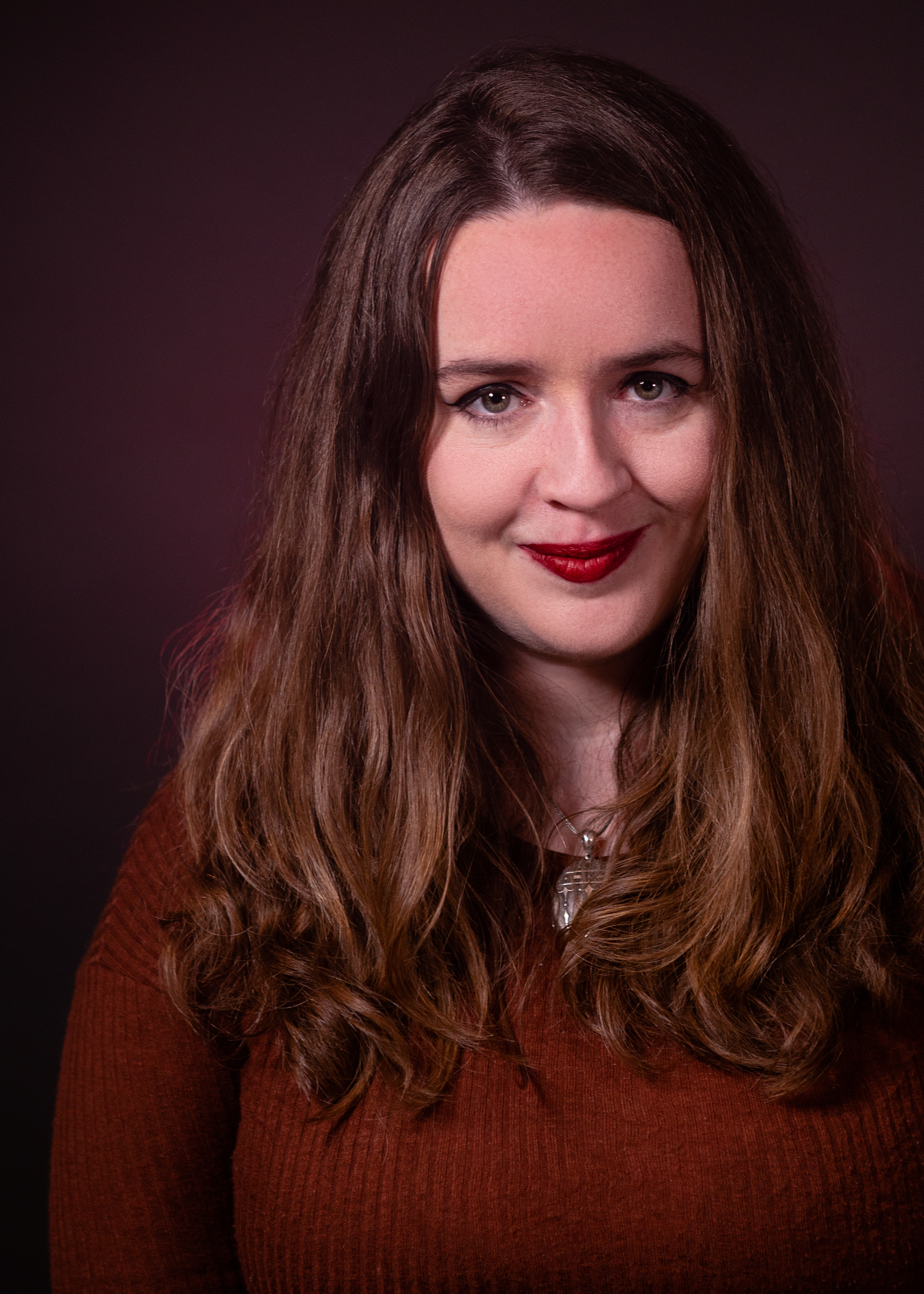
Kat Dunn grew up in London and has lived in Japan, Australia, and France. She has a B.A. in Japanese from SOAS and an M.A. in English from Warwick. She's written about mental health for Mind and the Guardian, and worked as a translator for Japanese television.She is the author of Hungerstone; her gothic horror novel Rottenheart will be published by Zando on October 13, 2026.
Tell me about your relationship to Hamlet, and how this idea started for you.
Hamlet was my favorite Shakespeare play growing up. I went to see a production in London as a teenager that cast Hamlet and Ophelia and Laertes as university students. It was a real revelation of: "This is teenage angst! It's angsty bullshit about your parents' terrible divorce and remarriage!" And that's something that I was living through. When you're very lonely with really difficult emotions, a piece of literature that seems to understand you is a light in the dark. And it stayed with me for a long time, so I had this idea brewing that it would be interesting to take Hamlet and reverse the genders, looking at stepmothers instead of stepfathers. Societally, we have a lot of thoughts about the stepparent experience, and particularly stepmothers.
Has your relationship to Hamlet changed over time?
In some ways, it lives in my mind alongside that version of me, because we don't ever really shed the 15-year-old version of ourselves. It's more that the way I reflect on myself and my feelings at that time changes the way I see Hamlet. It was a really interesting text to think about again. And I do love Hamlet, but fundamentally, he's really annoying. He's so irritating, but there's such pathos in that. We're often very intolerant of people who are suffering being really annoying. But the problem is that suffering is annoying! There isn't beautiful suffering to be had.
There's also something about being a teenager going through it; if our tolerance for adults suffering is low, then it's even lower for teenagers, because society says: "Oh, you don't know anything yet."
But in actuality, your suffering has doubled, because you don't know anything other than what you're in! You don't have any context or way of making sense of what's happening. And it's often something that truly does destroy your whole world, because you've grown up in a narrow sphere. I worked for a mental health charity for a while, and kids would be accused of acting out as a cry for help. It was presented as kind of the worst possible thing they could do, dismissed as: "Oh, it's just attention-seeking behavior." So I wrote material for the charity along the lines of: "But that's okay, because they probably need attention." We've absolutely stigmatized the idea that you might do something drastic or behave in unpleasant and difficult ways. But when you are powerless in your life, as you really still are when you're a teenager, what is left to you?
Most books require research, but those set in a different time period often require more historical research. What was that process for Rottenheart?
I've been a massive history nerd since childhood, so I have the accumulated detritus of decades in my head. Some historical periods are like a secondary world where I already know the structures and how life works. But not needing to do basic research allows me to do niche research, which is much more fun.
For this book, I looked at customs around death and mourning. One of the things I found was these memorials, which turn up in Rottenheart. It was a custom where you would write an account of somebody's passing and the time afterward, and it would be a memento passed down through a family. I read a book by Judith Flanders, who does a lot of accessible social history. The big point she was making is that we now consider dying a moment: the specific time where you're alive up until the moment you're now dead. But in the Victorian context, it was something actively happening for a long time, in the home, part of the family, very visible in a way that it isn't now. And it brought me back to my thoughts around how we tolerate suffering and how we articulate it.
This book is obviously relationship-driven, not just mothers and daughters, and stepmothers and stepdaughters, but, of course, Odette and Cecilia. What did you want to explore in their relationship?
I was thinking about the experience of when you are deep in the bad stuff, and you find somebody else who's in there too, and kind of gets it. When you're drowning, you can cling to somebody else and drown them in the process. Their relationship is both that they would not survive without each other, but also might not survive each other. That felt core to making sense of this Hamlet context. Hamlet suffers in a very male and externalized way, while Ophelia turns the suffering in on herself. So I thought it was interesting to take both [Odette and Cecilia] and have two different ways that they feel able to do something with their suffering. They're unable to say it to anybody else, which means that all the nastiness goes at each other, too. Because they so desperately need each other, they will take it far more than they should, because the alternative is to be so alone.
There's a lot of heaviness here, but was there any joy for you, in writing Rottenheart?
I'll be totally honest and say it was one of the hardest things I've ever done, writing-wise. But from a pure joy perspective, it was fun to invent Lydia's art career, to think about that playful and imaginative world that she and Odette could share, a place where their relationship was perhaps a fun thing to be in. I enjoyed writing the horror as well, the ghostly moments where I just get to lean into gothic-y London.
What are your own views on ghosts?
I don't believe in ghosts, and I have never had any kind of ghostly experience, but as with all things, one must be agnostic. Because we truly just don't know, and minds are not a reliable, trustworthy thing. It can go wonky for so many reasons and truly believe that you were experiencing or encountering something that isn't there. That frightens me much more than the idea of actual ghosts, because you are trapped in there with your mind.
Is there anything in particular you're hoping readers take away from Rottenheart?
There's a lot I still want to think and talk about in terms of what we mean by madness. I think there's something very complex in the way that we independently construct reality for ourselves and cast everybody else in certain roles to protect whatever narrative we need to be true. I am also thinking about how it's very hard to start to believe that maybe the things your parents say are not only just flawed on a human level, but can be actively negative, dangerous. And it's hard to see around the edges of that reality.
Really, madness and the reality of ghosts are kind of all coming at the same thing from different angles: What is shared truth? And what is it to be on the outside of who controls it? How mad do you go when that happens? But come back to me in two months, and I'll have a different answer for you. --Kristen Coates