Tuesday June 16, 2026: Maximum Shelf: The Memory of Borrowed Books
The Memory of Borrowed Books
by Meg Anderson
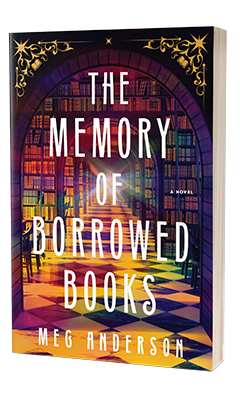
Meg Anderson's charming debut novel, The Memory of Borrowed Books, blends bookish intrigue, light fantasy, and escapist romance in an irresistible combination. As the librarian of cozy Foxhollow Bay, Mass., Claire Ashford appears to have an enviable life. She lives in a quaint, blue-shuttered cottage near the shore; she has her father, Jack, and her co-worker, Grace, for moral support; and she's flirting with Julian, a brooding patron who passes his days sketching at Foxhollow Library. But lately Claire has been fretting over the fate of the library. News is spreading that the board has plans to sell the historic building to a developer. Yet this library is a trove not just of books but also of local people's memories, held in the volumes of a magical basement archive. The secrets Claire discovers there help her to understand herself and her patrons, and bolster her determination to do whatever it takes to save the library.
Ever since Claire was a girl, reeling from the loss of her mother and afraid that her firefighter father might not make it home one night, Foxhollow Library has been "her comfort, a shelter from the sleepless nights that had plagued her since childhood." The insomnia and anxiety has never left her, and her father is still so worried about her that he calls his 30-year-old daughter every day. She knows she should be grateful for his concern, but she chafes at her father's overprotective attitude. A part of her is rebellious, longing for freedom and adventure.
And find it she does. One evening, after the library has closed to the public, she's in the basement and spots a door she's never noticed before. It opens into a room that shouldn't exist: an archive lined with towering shelves of glowing books with titles like The Summer I Forgot Her, What Wasn't Said, and The Morning We Should Have Held Onto. When Claire opens these magical books, she seems to be bodily transported into the scenes they depict, whether fragments of everyday domestic life or pivotal moments of decision. These are memories, she realizes. One book in particular captures her interest: The Night I Left, which shows her a forlorn man on a fog-shrouded bridge. The tableau is strangely familiar to her from Julian's sketches--but also from the mists of memory.
As Claire spends more time with Julian at the library, and on dates, she is drawn to his solemn courteousness and teasing sense of humor. She senses a deep sadness in him, though; a once-carefree nature has been buried under trauma. And as she reads from the basement archive at night when she can't sleep, she starts to piece together clues from his past. The Guilt I Carry replays Julian's high school years, when he, Quinn, and Eddie were inseparable friends. As graduation neared, Julian and Quinn paired off romantically and started to plan an escape from Foxhollow, while Eddie, caught between a violent father and a chronically ill mother, became resigned to the fact that he might never get to leave.
The mystery of how Julian and Eddie's friendship soured continues to mount as Eddie, too, becomes a frequent visitor to Foxhollow Library. Claire is frustrated that, 15 years later, the two men can't just talk through their ongoing issues. But Claire's attention is soon overtaken by her library's fate. The board, with its focus on budgets and statistics, has decided that the library is not fit for purpose and too expensive to maintain. There are discussions with a developer who proposes tearing down Elias Holloway's 19th-century building and replacing it with a multiuse facility: shops, café, and luxury condos. An indignant Claire prepares to fight. Luckily, she's not alone: locals with memories--happy or tragic--stored in that hidden room join to protest outside the town hall and tell the board how much the library means to them.
Anderson's fluid prose propels the tense questions building over what will become of the library and how the central relationships will evolve. The novel contains sensitive depictions of mental health struggles, including obsessive-compulsive disorder and suicidal ideation, yet the serious subject matter never overwhelms the gentle tone. The supporting cast is delightful, particularly Grace--a firecracker of sarcastic wit--and Gus, the faithful old dog Claire adopts. Like The Ten Thousand Doors of January by Alix E. Harrow, this isn't quite romantasy yet entices with hints of magic realism and a will-they-won't-they romantic subplot. The content is sweet rather than spicy, making the book suitable for teens as well.
In a prefatory note, Anderson characterizes The Memory of Borrowed Books simply as "a love letter to libraries." The idea of magical books that house memories is enticing, and no doubt will have readers thinking about the book-filled spaces that are significant to them. Bibliophiles have always known that books are magic, but Anderson's captivating first novel turns that idea into a literal reality. --Rebecca Foster
Sourcebooks Landmark,
$18.99,
paperback, 352p., 9781464278372,
October 6, 2026
Meg Anderson (photo: Amanda Hakes/Betty+Bobby Photography)
Meg Anderson resides in Indiana with her husband, three children and four very opinionated cats. She lives with multiple sclerosis, a part of her life but never the whole story. Writing has always been her outlet, and somewhere along the way, she discovered that putting words on the page helped her make sense of the world around her, sparking her love for writing stories.In her debut novel, The Memory of Borrowed Books, a Massachusetts librarian discovers a magical archive in the basement of her historic library building, which is threatened with imminent closure. The trove of memories she finds there helps her understand herself and her customers, including one particular patron and love interest, Julian. This "love letter to libraries" will be published by Sourcebooks Landmark on October 6, 2026.
What libraries have shaped you?
The library that shaped me most was my high school library. I was the girl who skipped the cafeteria and ate lunch between the shelves because it was the one place I truly felt seen. I learned early on that books and the places that hold them can feel like home, and that sense of comfort and belonging stayed with me long after I graduated. And, in many ways, that's what inspired The Memory of Borrowed Books. I wanted to write a story that honored that same magic libraries hold for people who need them most.
Now, I get to watch my own three children fall in love with stories inside our own small-town library, and I think there's something incredibly special about seeing that same sense of wonder passed on to them.
What are some other beloved places you had in mind when you were building the world of Foxhollow Bay?
One of my favorite things to do whenever my husband, three children and I travel is to look up the nearest library. Over the years, I've fallen in love with the way so many of them sit at the heart of their small towns, and through visiting all different kinds of libraries, I really found myself drawn to places that felt layered with history and memory, which also became such an important part of building Foxhollow Bay.
I loved the idea that Foxhollow Library was once the home of the town's founder centuries earlier, because so much of this story explores the way places hold onto people, carrying traces of both what's been lost and what still remains. I also think that's part of what makes certain places feel almost alive to us: their walls still remember the stories that came before.
Although Grace has heard rumors about a hidden room in the library, Claire seems to be the only one who can see it. Then when Julian gets hold of one of the magical books, he also journeys into its story. How did you decide on the "rules" for this archive?
I always intended for the hidden room to mirror the way our own minds work through compartmentalization and the spaces we create for the memories we try to protect ourselves from, ultimately burying or avoiding them altogether. That idea naturally led to the room only revealing itself when someone is truly ready to confront what they've been carrying, which is also why Julian is eventually able to access the books as well. And in a larger sense, the magical books then become emotional truths that characters have spent so long trying to outrun, finally forcing them to face the parts of themselves they've hidden away. But at its core, the hidden room was never really about magic alone, it was always more about what happens when we finally allow ourselves to remember.
The novel expounds on the idea that the truth only finds you when you're ready for it. What are some truths that you resisted or weren't ready for in your life, until finally you were?
I think one of the hardest truths I learned, especially while writing both Claire and Julian's stories, was that healing isn't always linear. Much like the memories hidden inside some of those books, there were once parts of my MS diagnosis that I wanted to lock away and never revisit again. But through writing this story, I found myself beginning to work through many of my own fears and uncertainties. It really taught me that while some grief never fully disappears, time does have a way of making it a little less heavy to hold.
All over the world, libraries face the threats of budget cuts, censorship, and closure. Does Foxhollow Bay offer a model for how to resist?
Claire learns that saving a library is never a task that can be done alone. She finds her voice through the people around her and realizes just how much the library matters not only to her, but to the entire town.
More than anything, I wrote this story for libraries and librarians everywhere. They are the backbone of the communities they serve, fighting every day to protect access to stories and the connection they provide. I hope this book reminds people to never underestimate the power of using their voice, even when it feels like no one is listening, because stories have always had the ability to move people, and when communities come together to protect the places they love, real change really can happen.
What would be Claire's ideal book-and-snack combination on a sleepless night?
Claire would absolutely reach for a well-loved classic like The Secret Garden on a sleepless night. It's one of the books she says once held her together when nothing else could. Alongside it, she'd most likely choose her longtime ritual of warm milk, a deep breath, and then back to bed, just like her mother used to tell her when she was little.
Are you working on another book? What can readers look forward to in the next one?
I am! My next novel still lives within that same magical, bookish world, but this time we're downsizing to Little Free Libraries. As much as I love libraries, I also have such a soft spot for those tiny ones, too.
This story explores identity and the paths we take in life--the ones we choose and the ones we leave behind. It looks at how we can love the life we have while still grieving the one we once imagined for ourselves. It's about realizing that it's never too late to reclaim that version of yourself you thought you lost. I cannot wait for readers to step into these pages and meet these characters. --Rebecca Foster