

 |
|
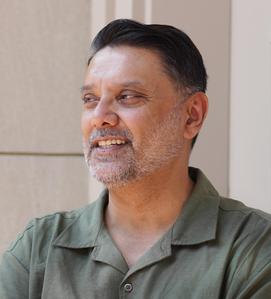
| Amin Ahmad (photo: Lauren Henschel) |
|
Amin Ahmad was raised in India and came to America at the age of 17. He worked as an architect for many years before turning to writing. His first two novels (as A.X. Ahmad) were thrillers--The Last Taxi Ride, The Caretaker--and his short story collection, This Is Not Your Country, won the 2020 GS Chandra Prize. He teaches creative writing at Duke University, and lives in Durham, N.C., with his family and a very mischievous cat. When he's not writing, he can be found on his front porch, drinking tea and watching the world go by. Ahmad's third novel, A Killer in the Family, will be published by Holt on April 7, 2026.
What was the initial spark, idea, or character that prompted you to write this book?
Sometimes I have an idea and it takes years for it to coalesce. When I came to the United States in 1985 to go to college, there were no novels about the Indian-American experience. I remember reading a lot of American classics like Faulkner and Steinbeck and Fitzgerald. The one novel that stuck with me was The Great Gatsby. I would re-read it over the years, but I didn't understand my attraction to it until I grew older and realized Gatsby is just like an immigrant. He changes his name from James Gatz to Jay Gatsby, tries to reinvent himself, tries to be accepted by the East Coast elite. That story was really poignant for me, and I always wanted to write an immigrant version of The Great Gatsby, because coming to this country and reinventing yourself is really an immigrant experience. Many years later, I picked up New York magazine and read an article about this Indian guy, a very wealthy real estate developer who was building an estate out on Long Island and re-creating India out there in this big, Gatsbyesque mansion--and things started just coming together. I started imagining a wealthy real-estate family, the Khans, and what kind of conflicts they would have, and the novel grew from there.
Power and who wields it is a strong theme in the novel and the characters access that power either with money or with information. Which one do you think is more important?
I think that what drives families is power dynamics. In the case of the Khans, of course money is a huge factor, because things can be bought and people can be bought. But at the same time, the whole book is about information: who has what information at what time, and there's a twist at the end of the book which has to do with information that's being withheld. Yes, money is a blunt instrument and it can definitely be used for clout, but if you know the deep, dark secrets of somebody's life, you could probably control them forever.
Immigration and acculturation also feature strongly here. Can you speak a bit about the differences and similarities of the immigrant experience within the Khan family?
The novel is really about two different generations, and how their experiences differ. The older generation of immigrants, like the patriarch, Abbas Khan, have had to claw and fight for every penny that they have. They've had to really extend themselves and operate in an alien culture, a Darwinian battlefield, in order to make their fortunes. When that older generation of immigrants becomes successful in America, they give every opportunity to their children, but when the children are more at ease here--they want to have fun and enjoy life--the older generations think, Ah, these people are soft. They're spoiled; they don't get it. They don't understand how hard the world is. This is the conflict between the first generation, who have no illusions about how power and money work, and their children who are born into a more sheltered, privileged life: the second generation are resented by their parents, who actually created this life for them and wanted it for themselves. So in my novel, the immigrant experience is deeply intertwined with the dynamics of the Khan family.
There are many delicious details involving art, real estate, and toys of the megarich here. How much research did you need to do to create the world of the Khans?
I trained as an architect and worked in architecture offices for about 15 years. When you're trained as a designer, it's a disaster, because it gives you expensive tastes for furniture and clothing and beautiful houses that you can't afford. So for a long time I lived vicariously through architecture and lifestyle magazines. I developed these visions about a certain kind of opulent, well-designed life, and when I wrote the book, I was like an art director with an idea of what I wanted--and I would go out there and find it. Thank God for real estate websites where you can see the inside of people's bedrooms or go through every room in a supertall skyscraper apartment. All these ingredients went into the stew, and it was very freeing. If I wanted to, I could put a $30,000 couch in Ali's living room. I could use elite designers to furnish his apartment and if I wanted Ali to give his wife an Issey Miyake coat from the latest collection, I could do it.
The Khans have enough secrets to carry them through several sequels (or prequels). Are you planning to revisit them in your next novel?
This book took me about 18 months to write. I was not well at the time, and sitting in a chair all day was hard for me. I thought, when I'm done with this book, I'm going to be so elated, I'm going to have a 10,000-pound monkey off my back. Plot-wise especially, it was a high-wire act towards the end to pull it all together. I thought, Once I'm done with this book, I'm going to lie on the couch and watch Netflix, go for walks, work out and get healthy. But instead, I got so depressed. I really missed the Khans and the excitement of living in that world. I can imagine writing a sequel and maybe even a third novel down the line, where the next generation of Khans grow up and want more power, and maybe they venture out into the realm of politics. While I would definitely love to write more about the Khans, my next novel has a different cast. It's a murder mystery set in the fashion industry in India. Still, it has all my obsessions in it, family secrets, the past, and all sorts of hidden dynamics.
And murder! There are many different themes running through A Killer in the Family but it is, ultimately, a mystery/thriller.
Genres like crime fiction, science fiction, and fantasy can be so liberating for writers of color because you can use that genre space to talk about identity, immigration, assimilation, capitalism, the underbelly of the American dream, rather than the usual immigrant story of coming to the U.S. and forging a life that has been done many times. When I teach Intro to Fiction, I actually teach it through writing genre. We start with fairy tales and move on to suspense, sci-fi, dystopian and magical realism, and what the rules are in all these different genres. It's very interesting to see my students absorb the rules of each world and then play with that form. It's liberating for them to realize that anytime you start with a form, you can modify it and make it your own. --Debra Ginsberg