

 |
|
|
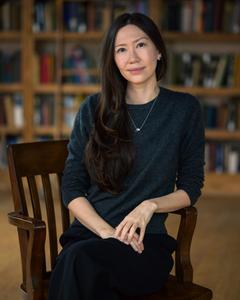
Ríoghnach Robinson |
|
Ríoghnach Robinson is the author of six YA novels published under the pen name Riley Redgate, including Alone Out Here. Her books have been published on four continents, optioned for film and TV, and named to best-of-the-year lists by ALA, Kirkus Reviews, and the New York Public Library. She is also the writer of the WEBTOON Originals series Angel of Death and has written for the Onion. Bad Words (St. Martin's Press, October 6, 2026) is her adult debut.
What spurred your transition from young adult to adult fiction? How has your experience differed this time from a publishing perspective?
My transition from young adult to adult was not something that I actively thought about. I wrote most of the draft of my first YA novel when I was a senior in high school, so I came to publishing relatively young and I felt like I had things to say about teenage life at the time. I've published six young adult titles in the decade since then and now, more of the questions I want to explore and the characters who come to me are adult. I do still sometimes get ideas for YA books and I'm not leaving it behind, but my focus has naturally shifted over time. In terms of it being a different publishing experience, I think that because young adult is an age category rather than a specific genre, there is a little bit less pressure to categorize it very narrowly. We've talked a lot about positioning for Bad Words in a way that I've never experienced with any of my young adult books.
There have been many books about books and publishing, not to mention novels about novelists. But there are very few novels about book critics. In your acknowledgments, you thank Tim Brayton, a film critic, for teaching you "why criticism matters." Can you elaborate on that--and why you chose to focus on literary criticism in the novel?
I started reading Tim Brayton's film criticism in high school. Tim is a film formalist, and his tastes are specific, and he speaks in such a fearless way. For somebody who feels as though they lean toward chameleonic or people-pleasing behavior, such as Parker, for instance, seeing somebody who fearlessly states something with the full force of their convictions is an inspiring thing. To this day, I have those feelings reading Tim's criticism, because the depth of his film knowledge is astounding. The detail in which he's able to analyze film language is just wonderful to read. For me, the level of engagement in criticism is sort of an act of love because it pays such close attention to what somebody has created. Selina would never dash off three lines online and dismiss a work and just call it a day because she reads the work so closely. What I find beautiful about criticism is the willingness to engage deeply with another person's art, even if you wind up hating it. I think the work that critics do is completely invaluable.
There are so many layers of Asian American experience in the novel; everything from Selina's feeling of disconnection from her traditional Chinese parents and Parker's close relationship with his boisterous Filipino family, to Parker's representation of Asians in his book and reactions of other characters to that. How important was it for you to capture all of these different perspectives?
One thing that feels universal in my experience of conversations around being Asian American is this feeling that you're being placed into a box and that there's so much more to you than what people are seeing. There is something limiting about being forced to focus on identity as if that is the most interesting thing about you. But the experience of being an American child of immigrants, like Selina, is very different than coming from a family who've been American for a while, like Parker. I think the sense of ownership in the diaspora is different. One thing I like doing with my Asian characters is to make their Asian identity part of the landscape but not the point of the book. There's a part where Selina admits that she doesn't like talking about or being public about what's going on with her family, because that feels reductive to her. When we meet both Selina and Parker at the start of this novel, they've both worked through most of their feelings about what it is to be a diasporic person. And this is not the focus of the book because it's not the focus for the characters. It's not the story that they're living through right now.
You have done a brilliant job capturing the rhythms of social media posts, as well as texting, emailing, and other electronic communications. Did this epistolary format come easily for you? Why was it important to make social media such a prominent part of this book?
I think what makes social media appealing to write about is that it has this intricate system of social rules. There are different rules than in offline reality, because people would not say the same sorts of things in real life that they do online. You're allowed to be more vicious, to go for the throat, as long as you are able to take a position of moral righteousness. If you can show yourself to have some kind of cause that's worth championing, you basically have carte blanche to say anything, which is wild. But you do have to pick the people whom you're okay with offending. When Parker and Selina are railing against each other, neither of them realistically believes that they're going to get 100% of people to be on their side, but they both accept, to some degree, that there are people who are going to disagree with them, and are going to hate them. You do want to believe that you can change hearts and minds, otherwise, why would you spend time arguing online? But with Bad Words, I wanted to explore just how difficult it is to change one person's mind.
Is it fair to say that, at its core, Bad Words is a celebration of the power of books to open worlds and even, as you say, to change one person's mind?
Yes, it is a love letter to the written word, which is a bit odd, because the first thing that the book does is to show the many ways in which the written word can devastate people, destroy relationships, and prevent relationships from ever forming. I think we see that online especially where there are so many ways in which a single bad faith interpretation of a single sentence can send a conversation spiraling and prevent you from ever knowing somebody. The book spends a while in that space but, ultimately, because it is a love story, the pleasure of it for me is peeling back that layer and getting to dive into the ways in which words can also connect us and be a profound form of love. I do think that reading someone's book is the best and closest way we have to know a whole person and to enter the heart and soul of another human being. --Debra Ginsberg