

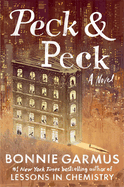
Bonnie Garmus laudably displays her admiration for and knowledge of poetry through narrator Batter Gray in her second novel, Peck & Peck, which takes its title from an erudite poetry quarterly headquartered in Manhattan. She demonstrates as great an appreciation for words, meter, and rhyme here as she did for science in her debut, Lessons in Chemistry. Mystery, romance, and poetry course through this enchanting tale of a twentysomething named for his parents' dog, and whose love for poems guides his path.
The novel opens when Batter is an adult, prisoner 83A0956. How does a poetry lover wind up in prison? That is the journey on which Garmus takes readers as she nimbly weaves the plot strands into a tapestry of words, colors, fealties, and betrayals, set against a backdrop of a changing late-1970s/early 1980s New York City, gritty and climbing out of bankruptcy (much like the periodical for which the novel is named).
Batter's mother designs typography and points out typefaces wherever she sees them, while his father is an ardent historian. As a result, Batter has approached poetry with the same kind of passion, since his school librarian introduced him to the poetry quarterly Peck & Peck when he was only 11.
In college, Batter, rudderless but inspired by Langston Hughes's "Mother to Son," writes a paper that earns him the admiration of his professor and the offer to write Batter a law school recommendation. "That's how I used poetry. To understand the world. To decode, analyze, interpret, think," Batter thinks, as his pre-law college roommate dismisses Batter's poetry reference. Batter eschews law school and moves to New York City, working three jobs to make his rent: running photocopy machines at Copy-A-Go-Go, folding clothes at the Gap, and working at a restaurant. In between, he attends amateur poetry readings. In search of one such event, Batter finds himself at a "classically beautiful" building graced by English boxwood topiaries and two glass domes: Peck & Peck. He overhears two people exiting the building; they're hiring. Batter interviews with editor-in-chief Salton Peck, and gets a job in the copy room, where he copies poems the 39 editors are considering, which must remain in the building. Batter even manages to win over his parents to his cause: "Just last week my poetry-averse father announced that in honor of me, he'd assigned Jabberwocky to his students. 'I couldn't believe it, Batter. It led to the most spirited discussion of the never-ending battle between good vs. evil I've ever witnessed.' "
With humor and intelligence, Garmus guides a story in which typefaces, history, and, of course, poetry all play major roles. Twins, like couplets in poetry, are an essential plot thread. Batter himself was a twin but--as he points out--like Elvis, he was the only survivor. Peck & Peck was founded by twins Patrius and Argentio in 1900. Cusp and Rye were the next set of twins to run the magazine in 1925. Twins Salton and Declonius were next in line to run the periodical, but Peck & Peck hurtled toward bankruptcy and each blamed the other for its demise.
Garmus's use of dualities creates a stereoscopic sense of depth for her characters and their conflicts: Declonius, forbidden from entering the magazine's offices, and Salton both develop a strong fascination with Batter and his intellect. A rivalry soon arises between Batter and Salton's assistant, Dexter, first over poetics, then over Dexter's "better half," a woman named Wren. Eventually, Batter is sent to work with 25-year-old starlet Xing Xing Yao, publicly perceived as "the Sexiest Woman Alive" while privately she aspires to poetic greatness instead. He coaches Xing Xing on her poems, saying, "Each letter is an atom, each word, a molecule; together they create phrasing, and phrasing gives rise to substance." Through a series of twists and turns involving her poetry notebook and diary, Batter finds himself at the center of a criminal conspiracy for which he is imprisoned, as Peck & Peck once again wobbles on the edge of existence.
What unites these eclectic perspectives is the powerful draw of poetry, often for unexpected reasons. And while poetry provides a springboard, relationships provide the heart as Garmus skillfully navigates through drama and humor as the players follow their passions. She does an especially strong job of contrasting Peck & Peck's lofty mission with the political dynamics of its corporate environment, as represented within its twinned office domes. The best poetry lingers because of a surprise--an unexpected turn of phrase; a double entendre that opens up the poem's meaning. And this is precisely what Garmus does: she proves that poetry is born of emotion, unlocks hidden truths, and is essential to humanity. As she concludes: "Originality. Beauty. Substance.... Anything less is extinction." --Jennifer M. Brown