

 |
|
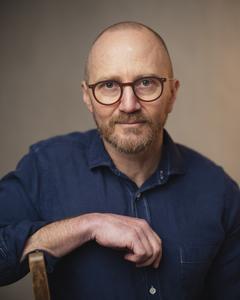
| Dr. Chris Cleave (photo: Tom Trevatt) |
|
Dr. Chris Cleave is an existential psychotherapist, practicing psychologist, and writer whose work explores how human beings recover meaning, connection, and agency after trauma. His five novels--including Everyone Brave Is Forgiven and Little Bee--have been translated into 35 languages, and he has spent two decades writing about the inner lives of people under extreme pressure. Human Again, his first work of nonfiction, is a hopeful practical guide to understanding why so many of us feel overwhelmed, disconnected, or stuck--and how we can restore our relationships with ourselves, one another, and the world we're living in. Alongside his literary career, Cleave maintains a clinical practice in London.
How has the process of writing nonfiction differed from writing novels? What has been most challenging about the transition?
What I wanted to do with Human Again was write something that was genuinely and immediately useful for people, a book that was medicine in itself. And to do that, I needed to talk to people in my own voice, finally, and say this is what has worked for the people I see in my work as a therapist, and this is alsowhat has brought me back to life and helped me find joy. But there was an enormous vertigo of writing nonfiction and a feeling of being naked that was at once scary and liberating. I was a kid who was lonely, sad, and who wasn't always allowed to be himself, so I learned to tell stories and became a novelist. That's what kept me alive. Because I love people and am curious about how they survive in the world, my novels are about people who have endured trauma and the psychology of that. But when you're writing a novel, it's always in code, you're always wearing a mask. When I hit 50, I thought, maybe I can take the mask off now and speak directly to the people I know and love, which is this global community of readers who have always accepted me. That was a big moment for me because I was so used to hiding who I was.
Therapists famously keep their own lives private, but you write extensively about your personal life experiences and struggles in the book. Was it difficult to share yourself on the page in this way? Or did it feel liberating?
I don't think this is an age in which we can afford to hide our hearts. In the same way you don't want to hoard money, you don't want to hoard your own life story either, or your own secrets, or your own knowledge. For a long time, it has served me well to keep that kind of firewall between the world and me. That's what helped me to be a novelist and to be a therapist. But there comes a point where you need to stop hoarding it, like a dragon with gold in your cave. I've worked with so many people who have been brave enough to tell me their stories and trust me to respect them and not judge them. I have my own therapist and my own supervisor and I've told these kinds of stories to other people who have handled them with love and respect, and I expect the world will treat me with love and respect. I talk about this idea in the book, that if people have let you down and abused your trust then actually you need to trust people more, not less. You need to let go of shame, let go of this idea that there's something to judge in your life.
How close are we, in your opinion, to a tipping point where we risk losing our ability to connect with our own humanity?
I think the fact that you're asking that question is our defense. I think the pain that we're feeling, all of the flashes of fear and hate and anxiety and guilt, is the feeling of something within us that doesn't want to disappear. This is our deep humanity, and our collective feeling for each other and for the planet. The fact that it's hurting should fill us with hope. If we were feeling nothing as we accelerate into this very dark age, then we would need to worry. But I don't worry that there's a tipping point that we cannot come back from because our humanity is extremely stubborn. It will survive very dark times, and maybe it will need to now. But I also think that we can't be complacent about it. Our humanity is a resource and an ecosystem, just the way the rain forest is, so it will grow back but we need to make it our business to grow it back. That is our main job right now, to reinhabit and regrow our humanity itself.
On a related note, do you think that AI (which is, by definition, not human) is impeding, or perhaps even destroying, our ability to connect with our human nature?
I'll say something really serious here, which is that we mustn't pin all of our human evils on AI.
Dehumanization is something people have done to each other long before AI showed up. For example, the times that Europe fell into in the 1930s and '40s was a dehumanization of entire groups of people by other groups of people. We didn't need AI to do that for us. A lot of what is happening in our world at the moment has to do with a resurgence of those dehumanizing energies where we excuse ourselves of our own duty of human empathy, human care, human compassion, and human inclusion in the name of some political or economic view. Yes, AI is accelerating that process, but we built it. We need to not let ourselves off that hook. But I would also say that AI is revealing what is available to be lost and people are resisting that loss. There are debates about how much we should use AI and what this resistance reveals is an opportunity to rehumanize ourselves.
Is there cause for optimism despite these difficult times?
I think the message of the book is that we can certainly start to function better within our own worlds. We can start to repair the relationship between what is surfacing in those difficult feelings, which is our humanity, and the world in which it was always meant to live. We can re-create those conditions around ourselves, and then once we've made our personal world a more livable and humane environment, it automatically starts connecting to all the people who are doing this as well. This is not a book that says we can do everything on our own, but it is a book that says, actually, it's amazing how much we can do. We do need political change and we do need social change, and we can't do all of that on our own as individuals, but we can meet the process halfway and do much more than I think we realized we could. And so, when you look at these deep human practices that our ancestors knew how to do and that we have started to forget how to do, you realize the wisdom in them. When we neglect them, the symptom is that we start to feel a bit crazy. We're not crazy, we're just dehumanized, and there is a way to get that humanity back. --Debra Ginsberg