

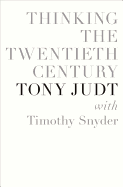
In September 2008, historian Tony Judt was stricken with ALS, a disease that would take his life within two years. Four months after that terrible diagnosis, though, he began Thinking the Twentieth Century, an unusual collaboration with Timothy Snyder, a Yale professor specializing in Eastern European history--an expansive, challenging series of dialogues in which the two trace the major currents in the intellectual history of 20th-century Europe. Judt and Snyder draw on rich stores of reading and reflection to explore the ideological clashes that marked the last century.
There are moments when one's attention may wander at the mention of some unfamiliar Eastern European economic or political thinker, but this is a true conversation, not an arid academic colloquy. Judt and Snyder never lose sight of the grand sweep of events and personalities marking an era that "began with a catastrophic world war and ended in the collapse of most of the belief systems of the age."
Framing each of the book's chapters are fragments of Judt's biography, many of which reveal the events that shaped his political beliefs. Although the English-born Judt was Jewish, for example, he traces his antipathy to the current state of Israel to his experiences there after the Six-Day War in 1967. Because Judt's fearless opinions are expressed so pointedly and with such passion, it's unlikely readers will ever find themselves in total agreement with him. But whether one adopts or rejects his worldview, this invigorating dialogue grants us the privilege of encountering a fertile mind in all its vibrancy, gone far too soon. --Harvey Freedenberg