

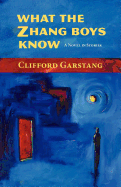
Inside the Nanking Mansion, a 12-unit tenement rehab near Washington, D.C.'s haphazardly gentrifying Chinatown, you'll find a contemporary urban Yoknapatawpha County. The hodgepodge community of artists, writers, romantic couples, immigrants, low-level Washington attorneys, real estate developers and bureaucrats in Clifford Garstang's What the Zhang Boys Know is a mosaic of our own world of modest ambitions, disappointments and underlying compassion.
Garstang's "novel in stories" shows a strong command of character and voice, with frequently lyrical descriptive details. A schoolteacher, for example, recounts his walk to work "on a glorious damp Friday, when the daffodils had just opened, bringing color back to D.C. after a bleak winter filled with government scandals and terror alerts. The sunny darlings were everywhere the sight of those buttery trumpets put a spark in my step." Of course, it is not all flowers and sunshine in the Nanking Mansion. The recently widowed Chinese immigrant Zhang Feng-qi must bring his dying father from Shanghai to care for his two young sons. A gay couple's beloved pet is dog-napped during a mugging and their relationship unravels; one of them stubbornly takes to his bed where he can only stare off with "eyes sad as an Emily Dickinson poem."
"[On] a street where refurbished Victorians rubbed shoulders with burned-out brownstones and crackhouses," Garstang has one prospective buyer say of this Faulknerian world, "the condo building, at least, seemed like a self-contained oasis." Garstang's finely painted portrait of displaced people who find support in each other is its own "buttery trumpet" in a cacophonous landscape. --Bruce Jacobs, founding partner, Watermark Books & Cafe, Wichita, Kan.