

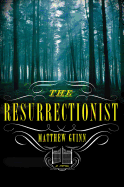
For centuries, every medical student's rite of passage has been the gross anatomy dissection class. Cadaver dissection was even more important 150 years ago, when it was the only effective way for potential physicians to see how the body works. In the late 1850s, however, there was no consistent process to obtain those cadavers.
Matthew Guinn's debut novel, The Resurrectionist, is the story of Jacob Thacker, a recent graduate of the fictional University of South Carolina Medical School, and his discovery of the school's unsettling past--the story of a Senegalese slave named Nemo Johnston, who was purchased by the founding faculty members a few years before the outbreak of the Civil War.
Jacob, serving as the school's public relations director while he waits out a postponement of his medical license for Xanax abuse, launches a PR campaign to celebrate the renovation of the original Medical School building, but the first day of excavation uncovers a mass cache of human bones. Library archives reveal Nemo's role as the "resurrectionist" who digs up freshly buried slaves for the school's dissection classes.
Guinn's narrative alternates between the story of Jacob's personal ambitions and discomfort with his past and the story of Nemo, shunned by his fellow slaves and damned by their local preacher as "hell-spawn." The novel effectively raises questions of how the country can transcend its own racially difficult past--and learn from those who have come before, as physicians do, that "the dead are the key to the living." --Bruce Jacobs, founding partner, Watermark Books & Cafe, Wichita, Kan.