

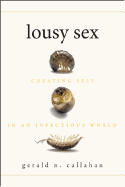
Lousy Sex attempts to answer the ages-old question of what is self, but instead becomes a fascinating memoir that fuses science and philosophy into a poignant portrait of the human self. (The title is a pun referencing the bacterial infection that turns wood lice into self-reproducing females.) Gerald Callahan, an immunologist at the University of Colorado, uses his considerable expertise to explain the divergent themes of biological self--immunity and the evolutionary ways cells have evolved in distinguishing "self" from "nonself"--and psychological self--the brain's connections to thought and creativity.
Ranging between the science, religion and philosophy, Callahan's more personal recollections question the entirety of self within the context of his own humanity: an almost detached description of his mother's test for Alzheimer's and subsequent admission into a nursing home for care; a Thanksgiving car accident that leaves his wife physically disfigured and the efforts to restore her to her former self. In one passage, he uses multiple sclerosis as an example of a brain-body destroyer to illustrate how infectious diseases have allowed science to unlock the dark secrets of the human soul.
Callahan's prose is more poetic than scientific. He imbues a sense of wonder in his subject while punctuating how entwined our biological and psychological halves are to one another--destruction of one leads to a sense of loss for the other. --Nancy Powell, freelance writer and technical consultant