

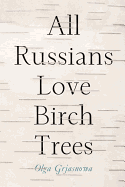
For many American readers, Olga Grjasnowa's All Russians Love Birch Trees, an award-winning German novel about displaced people, will be a disorienting experience. Its narrator is a young woman named Masha, studying to be an interpreter for the United Nations. She is a Russian Jew, raised in Germany after ethnic conflict forced her parents to flee Azerbaijan; she speaks Russian, French, English, German, Arabic, Turkish and Azeri, with varying degrees of fluency. She and her Lebanese Arab boyfriend belong to a lost generation, constantly struggling to reconcile their linguistic, national, ethnic and religious identities.
Early in the novel, a sudden, tragic event sets Masha adrift. She floats between Germany and Israel, occasionally falling in with a new friend or an old lover. Eva Bacon's translation is clean and lucid--a quiet, understated first-person narration that belies the depths of Masha's pain and confusion.
Grjasnowa makes a conscious effort to guide the reader through a forest of tensions, from loaded terms like "postmigrant" to the difference between the way a third-grade teacher treats a newly arrived French student versus a German-speaker of Russian descent. Although it's impossible give the reader an instinctive understanding of Masha's struggles, Grjasnowa elegantly balances explanations and demonstrations so that Masha's world comes to feel almost familiar. All Russians Love Birch Trees is part of a new global literature that sees foreignness as a condition of familiarity, that understands alienation as a way of life. --Emma Page, bookseller at Wellesley Books