

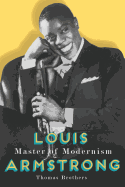
When Louis Armstrong died in 1971, he was beloved across the world. In jazz circles, he was known as Satchmo; to the world at large, he was the big-smiling Pops, the man whose natural ease with people of all races and nationalities made him the Ambassador of Jazz.
Music historian Thomas Brothers focuses on the drive, discipline and ambition that lifted Armstrong from a young New Orleans hotshot cornet player in the early 1920s to a sophisticated master of modern jazz within two decades. Brothers doesn't shy from Armstrong's checkered history, addressing his women (four wives and an unknown number of girlfriends), his lifelong marijuana use and his self-serving break from his early mentor Joe "King" Oliver. The focus, though, lies much more on the music. Brothers analyzes in depth the songs that defined Armstrong--hits like "Cornet Chop Suey," "Heebie Jeebies," "Big Butter and Egg Man" and "West End Blues" through which he developed a singing style ("full articulation, half articulation, blurred speech, and scat") to accompany his blistering horn solos.
With these breakthroughs, Armstrong became an entertainer who could move from the black dance halls of Chicago's south side to the tony white clubs of its north shore (for which he would be regarded by many African-Americans as a sell-out). According to Brothers, Satchmo understood that "breaking into the white market meant heavy emphasis on popular tunes," a skill he mastered even after he blew out his lip and couldn't hit the high notes any more.
With archival photographs and extensive endnotes, bibliography and discography, Louis Armstrong: Master of Modernism provides a complete picture of the critical decades that created the popular Ambassador of Jazz. --Bruce Jacobs, founding partner, Watermark Books & Cafe, Wichita, Kan.