

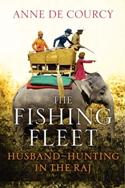
In The Fishing Fleet, Anne de Courcy (The Viceroy's Daughters) takes on the Raj--a period lasting from 1858, when the rule of the British East India Company was transferred to the crown, until 1947. During that time, women as young as 16 were packed off to India because, as de Courcy explains, "the gently born, softly brought up middle-class woman... was ill-equipped to support herself" and the pool of potential husbands at home was dwindling. The alternative was eternal spinsterhood.
De Courcy draws on reams of letters, memoirs and diaries, in addition to a comprehensive bibliography of all matters Raj. This embarrassment of riches at times threatens to overwhelm her narrative, which can get repetitive with details of finery and merrymaking. The most compelling parts of The Fishing Fleet focus on the trip out and the anecdotal reminiscences. Despite the inconveniences of sea travel, waves of women continued to arrive in India, where the ratio of men to women was 4 to 1. If a girl wanted a husband, she could find one, or he would find her. If the man was in a hurry to get back to his plantation, an acquaintance might lead to a proposal in less than two weeks.
Then, the miseries really began. Wives were often stuck in isolated outposts, with the nearest woman five miles away. Disease was rampant, sometimes striking in the morning and causing death by evening. Despite all, these stalwart English girls stuck it out and came to love India. Perhaps this is one of the reasons there will always be an England. --Valerie Ryan, Cannon Beach Book Company, Ore.