

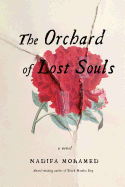
As harrowing and bleak as war and violence are, it takes a masterful writer to mine such an environment for hope. In The Orchard of Lost Souls, the Oxford-educated Somali native Nadifa Mohamed (Black Mamba Boy) does just that, broaching a real tragedy with fictional artifice and enlivening a cast of characters so full and lifelike the reader might be sad to lose their company at the novel's close.
Mohamed's rendering of a country on the brink hits readers like a piece of reportage: she spares no details describing the homelessness, violence and famine than ran rampant in Somalia during the late 1980s. Despite it all, the novel finds balance in its characters' humanity. The three women at the heart of the story weave into and out of each other's lives like ants trapped in the same maze. Deqo, a nine-year-old orphan, seeks family in the confines of a brothel; Filsan, a 30-something government soldier, tries to climb the professional ranks and shed her past; Kawsar, a 50-something widow, clings to the friendships and way of life that seems to slip through her hands, little by little.
Through all three stories, Mohamed's use of color is salient, a landscape painted in aqua blues, desert oranges and wine-red dyes whose geography is as vibrant as its culture. The language is one of the novel's major draws, but you'll keep reading for the women at the center--three compelling and evocative characters whose humanity persists in the face of inhuman tragedy. --Linnie Greene, bookseller at Flyleaf Books, Chapel Hill, N.C., and freelance writer