

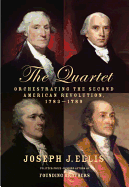
To the modern American, the United States seems a foregone conclusion of the Revolutionary War. But in The Quartet: Orchestrating the Second American Revolution, 1783-1789, historian Joseph J. Ellis (American Sphinx, First Family) argues that nationhood was not a goal of the Revolutionary War, and that at the end of the war, the only connection among the colonies was their resolve to remain free of empire. Comparable to today's European Union, the 13 colonies were a collaborative collection of independent entities.
The politics of the nascent nation changed rapidly between 1783 and 1789, due largely to a quartet of men: George Washington, John Jay, Alexander Hamilton and James Madison. Washington and Hamilton both witnessed firsthand the ineffectiveness of the Continental Congress, instilling in them a desire for a strong, central leadership. Jay spent years in Europe setting American foreign policy, which convinced him that the United States needed to appear united internationally. Madison's political genius made him certain that a confederation would never succeed.
These men were perfectly positioned politically to be able drastically to shift American policy away from boundless independence and back toward centralized authority. By establishing the Constitution and setting the framework of the federal government, in essence they staged a bloodless revolution.
Absorbing in its details, and convincing in its arguments, The Quartet is sure to appeal to history nerds and American politicos. As another election season approaches, a look back at the creation of the government, and the reasons why these founding fathers did what they did, is sure to be engrossing reading for anyone. --Jessica Howard, blogger at Quirky Bookworm