

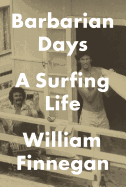
William Finnegan (Crossing the Line; Cold New World), staff writer for the New Yorker, first got the surfing jones as a kid in Los Angeles, and nurtured it when his TV producer parents moved to Honolulu at age 14. A shy, reclusive white boy in a school of local Hawaiians and Asian immigrants, he found escape and friendship in the waves off shore from their cottage on the wrong side of Diamond Head. As he recalls in his memoir Barbarian Days, "the surf was your refuge, your happy hiding place, but it was also a hostile wilderness... an uncaring God, endlessly dangerous, power beyond measure." For the young Finnegan, surfing anchored him throughout the turmoil of his teens and then took him across the globe in search of bigger waves and broader adventures.
Barbarian Days is the detailed chronicle of his years of travel, friendship, romance and political awakening. His journey took him through the South Pacific islands to Australia, Indonesia and finally Cape Town--where teaching in an apartheid South African black high school "changed me... turned me toward politics, journalism, and questions of power." While Finnegan explores his own intellectual growth, Barbarian Days is primarily a surfing story of shortboards, "left" and "right" waves, and big swells with nicknames like Restaurant and Racetrack. In all, Finnegan might relate to Shake Shack founder Danny Meyer's recent comment about his growing food empire: "You can't become a champion surfer in a bathtub." --Bruce Jacobs, founding partner, Watermark Books & Cafe, Wichita, Kan.