

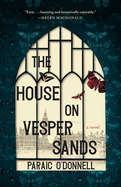
London, 1893: There's murder with a supernatural aspect afoot. The man on the beat has a high opinion of himself, a disarming sidekick and what one citizen calls "a weakness for certain exotic cases." No, The House on Vesper Sands is not a Sherlock Holmes mystery, but Paraic O'Donnell's sophomore effort is the next best thing.
On a snowy night, a seamstress at the home of Lord Strythe, the Earl of Maundley, throws herself out the window. The autopsy yields something remarkable: a cryptic phrase is embroidered directly on her skin. That same night, Gideon Bliss arrives at the London boardinghouse of his uncle, who has written to summon his nephew from Cambridge for a reason undisclosed. Not finding his uncle at home, Bliss takes shelter at a church, where he encounters Angela Tatton, a flower maker he befriended when he was last in London. Tatton is behaving strangely, as though she has been drugged. Before Bliss can fetch a doctor, he gets knocked out. When he wakes the next morning, Tatton is gone.
Bliss returns to his uncle's boardinghouse; still the man is not at home. In an act of subterfuge wildly out of character for a mild-mannered lapsed divinity student, Bliss poses as the officer assigned to the Metropolitan Police's Inspector Henry Cutter, another lodger. Bliss intends to convince Cutter to look into the disappearances of his uncle and Tatton. That Bliss is ill-suited for fighting crime isn't lost on Cutter. "You have the constitution of a consumptive poet" is among the gentler insults he lobs at Bliss.
O'Donnell, an Irish novelist, makes his U.S. debut with The House on Vesper Sands, a story that brings humor and darker themes into richly rewarding alignment. --Nell Beram, author and freelance writer