

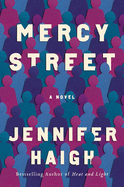
A novel revolving around a women's clinic that performs abortions would seem to promise a powder keg's worth of drama, but Jennifer Haigh's Mercy Street offers something more nuanced than merely a fiery clash between politically polarized camps. Haigh's efforts to understand people who are part of the abortion fight, on the front lines and on the fringes, yield quieter--but no less searing--results.
Mercy Street opens on a snow-blighted Ash Wednesday as anti-abortion protesters are gathered, as always, in front of Mercy Street, a women's clinic in Boston. Meanwhile, Vietnam veteran Victor Prine has his own determined way of protesting the abortions the clinic performs. The novel's roving point of view also introduces Anthony, who is on disability and works as Victor's "lieutenant"; Claudia, a social worker at Mercy Street, who grew up in a single-wide trailer; and Timmy, the weed dealer Claudia patronizes to find relief for her anxiety, not all of it brought on by her high-stress job.
Expertly tailoring her narrative to capture each principal character's sensibility, Haigh (News from Heaven) stirs the political pot slowly but steadily: her novel is aswarm with opinions on not only the right to choose but also the First and Second Amendments. The poverty that storms its way through Mercy Street is one of the novel's tragedies. Claudia, for instance, is well aware that "social work was therapy for people without money, for people like her." Another of the story's tragedies is the loneliness that engulfs Haigh's characters, no matter their political stripes. --Nell Beram, author and freelance writer