

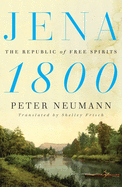
Poet and philosopher Peter Neumann's Jena 1800: The Republic of Free Spirits, translated from the German by Shelley Frisch, captures the epic year in which a group of free thinkers set up house in the history of ideas. In 1799, the French Revolution came to its ignominious end via Napoleon's coup d'etat, but in the German city of Jena, the revolution of ideas was just getting started. With only about 5,000 residents, most of them university students, Jena was considered the intellectual and cultural center of Germany at the beginning of the 19th century, offering a haven for the intellectually intrepid to rethink the world and its ways. In 1800, a small circle of friends and fellow "free spirits" resolved to do just that, living and working together to create a republic of the mind.
The coruscant, unconventional thinkers who converged on Jena in 1800-1801 included the elder statesman and revered writer Johann Wolfgang von Goethe; translator August Wilhelm Schlegel and his controversial wife, Caroline; August's brother, the philosopher and poet Friedrich "Fritz" Schlegel and his wife, poet and translator Dorothea Schlegel; Friedrich Schelling, the philosopher who helped pioneer the German Idealism movement (and wooed the married Caroline); and the Romantic poets and philosophers Ludwig Tieck and Novalis. In lucid and colorful vignettes, Neumann brings to life an industrious and clever clique, who questioned society in a post-revolutionary Europe still leery about "freedom fever" in academia. One doesn't need a philosophy degree to enjoy this enchanting account of the power of ideas to change the world. --Peggy Kurkowski, book reviewer and copywriter in Denver, Colo.