

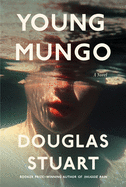
In Young Mungo, the follow-up to his Booker Prize-winning debut, Shuggie Bain, Douglas Stuart delivers a gay bildungsroman suffused with drama and gorgeously realized emotion.
In the postindustrial gloom of the early 1990s, Glasgow's East End is an environment of deprivation and strife. Fifteen-year-old Mungo Hamilton, born to a Protestant family and named for the city's patron saint, seems ill-quipped to navigate it. With neither his sister's headstrong practicality nor his brother's warlike machismo, Mungo is naturally, helplessly sincere: "It was a funny thing to be a disappointment because you were honest and assumed others might be too." Although seemingly incapable of dissembling (his good looks are undercut by a facial tic that betrays his nerves), Mungo must hide the truth when he falls in love with James Jamieson, a Catholic boy from a nearby tenement. Under threat from a culture that enforces its codes of masculinity with violent zeal--embodied by Mungo's sadistic brother, Hamish, who treats his hatred of Catholics like a blood sport--the two boys find their futures imperiled.
Stuart's depiction of a powerful, enveloping first love is rendered with stunning emotional clarity. No less poignant is the protagonist's relationship with his mercurial, alcoholic mother. Despite her selfishness and casual cruelty, Mungo's love for his Mo-Maw is abundant: "It was a harvest that no one had seeded," Stuart writes, demonstrating a disarming facility for metaphor, "and it blossomed from a vine that no one had tended." With the author's profound capacity for feeling and a canny sensitivity to the nuances of class and sexuality, Young Mungo confirms Douglas Stuart as an artist of rare talent. --Theo Henderson, bookseller at Ravenna Third Place Books in Seattle, Wash.