

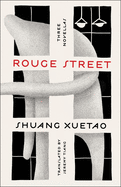
The three novellas in Rouge Street, Shuang Xuetao's prodigious English-language debut, feature multilayered voices revealing intricate perspectives that result in gloriously gratifying rewards. Booker Prize finalist Madeleine Thien introduces Shuang's enigmatic work, contextualizing his fiction, which "teeter[s] on a fulcrum between past and future," between Mao's China and the country's global rise. Award-winning writer/translator Jeremy Tiang follows with a detailed explication of the title's origin--a reference to Yanfen Street, Shuang's childhood neighborhood in the northeastern Chinese city of Shenyang. Shuang recalls his early home "as a run-down place of dirt roads and dingy houses," populated with neighbors who were "thieves, swindlers, con artists, drunkards, and gamblers."
That milieu is exactly the setting of all three stories, beginning with "The Aeronaut," which follows the interconnected Gao Likuan and Li Zhengdao families throughout the decades. "Bright Hall" is another multi-faceted narrative, about a sculptor robbed of his middle fingers to prevent him from creating another "reactionary clay statue"; a boy sent to live with an aunt and cousin he's never met; and a bully being raised by his grandmother, who never gives up hope of finding the mother who abandoned him: these threads intertwine at the bottom of a frozen lake. Finally, seven voices relay the events of "Moses on the Plain," which involves the murders of five taxi drivers in a single month in 1995.
Shuang's crisp, unadorned sentences might seem to contrast his fantastical twists and turns, but that irresistible combination is waiting to be discovered by lucky new audiences. --Terry Hong, Smithsonian BookDragon