

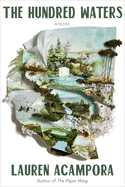
In the tradition of territory-marking novelists John Cheever and John Updike, Lauren Acampora expertly captures deep-pocketed suburban restlessness in The Hundred Waters. But while she's sketching the particular emotional bankruptcy that can dovetail with a distinctly American brand of prosperity, Acampora contemporizes the suburban milieu by suggesting that social media and the climate crisis should be among any community's concerns.
In her New York days, Louisa Rader was a model who aspired to be a photographer. She has since moved back to the Connecticut suburb of Nearwater, where she grew up, to raise her now 12-year-old daughter, Sylvie, with her architect husband. Louisa is the director of the Nearwater Art Center, which she hopes to turn into something more than a showcase for local hobbyists and, yes, maybe even a place to exhibit her own work. At a dinner party at the home of two art collectors who are new to Nearwater, Louisa happens on some startling animal-centered paintings by the couple's 18-year-old son. His work will make a life-altering impression on both Louisa and young Sylvie.
How easy it would have been for Acampora (The Paper Wasp; The Wonder Garden) to shape her story into a takedown of moneyed people whose every home, Louisa wagers, contains "family portraits on the beach." But The Hundred Waters is after something larger in scope and fundamentally humane. Through its delicate narrative circuitry and roving point of view, the novel gradually exposes a community that's in crisis without even knowing it. --Nell Beram, author and freelance writer