

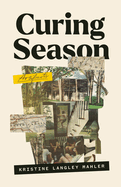
Kristine Langley Mahler's Curing Season: Artifacts is an essay collection selected for West Virginia University Press's In Place series, which features strongly place-based literary nonfiction. In these often experimental essays, Mahler considers a brief but powerful part of her youth spent in eastern North Carolina: four years of preadolescence in which the young Mahler struggled with feeling that she didn't belong. While this is arguably a universal preadolescent experience, Mahler's story is indelibly linked to the community in which she lived, made and lost friends, and attended school.
In Pitt County, N.C., the author encounters matters of race and class for the first time. The profitable sale of her family's home in Oregon has enabled them to enter a prosperous suburb where her neighbors attend cotillion. White children, like Mahler, who go to public school are bussed into a majority-Black part of town as part of 1990s desegregation efforts. Her neighbors' families seem to all rely on generational relationships to the place. She feels her outsider status at every turn.
While some essays use relatively straightforward narrative storytelling, others are fragmented, rely on images or borrow forms from other works. Mahler explores astrology, references Joan Didion's famous rational detachment and borrows lines from Margaret Atwood's Cat's Eye and the local history Chronicles of Pitt County. "I grafted my history onto theirs; I twisted the lessons until I could wring out similarities between my past and theirs." Mahler's investigative ponderings on belonging, displacement and a sense of home are both specific to place and universally familiar. --Julia Kastner, librarian and blogger at pagesofjulia