

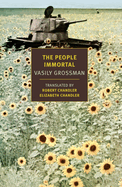
From Vasily Grossman (1905-1964), the master 20th-century Ukrainian Soviet novelist of Stalingrad, Life and Fate and Everything Flows, comes The People Immortal, translated by Robert Chandler and Elizabeth Chandler. The novel--set in Eastern Europe in the early days of Operation Barbarossa, the Nazi invasion of the Soviet Union--is a tragic but stirring story of enduring against impossible odds. It tracks a single unit ordered to defend its position, with minimal support, against a massive invading force.
Part novel, part at-the-front war journalism and part inspirational propaganda, the novel was surely written in large part to bolster morale during the time when Nazi Germany was at the height of its highly organized, technologically sophisticated powers, the eventual Allied victory by no means assured. Nonetheless, Grossman exhibits keen powers of observation, analysis and humor--and an immense, stubborn affection for the human spirit, even amidst its worst manifestations. This makes the novel a riveting drama that is still boldly critical of dysfunctional military bureaucracy and Soviet magical thinking (its excessive optimism and despair).
In its precise descriptions of military tactics and strategy, its individual human stories--civilians caught up in the maelstrom; enlisted men; military officers, both Soviet and German--and its philosophical reflections, the novel's cross-sectional threads cohere into a striking narrative tapestry. And in its evocative depictions of the characters' past lives, The People Immortal relates the history of a people, a community and a nation, all set in the present tense against (in a dark irony) the beauties of late spring bursting into summer. --Walker Minot, freelance writer and editor