

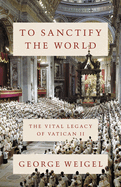
The Second Vatican Council ("Vatican II") was a pivotal moment for both the Catholic Church and the world, and George Weigel (Letters to a Young Catholic; Witness to Hope) brilliantly explains why in To Sanctify the World. Described as the "most important event in the history of Catholicism since the Council of Trent responded to the various Protestant Reformations of the sixteenth century," Vatican II (1962-1965) was born of Pope John XXIII's "great hope... [to] launch a new era of Christ-centered and evangelical Catholic vitality." Weigel, a senior fellow at D.C.'s Ethics and Public Policy Center, positions Vatican II as the spiritual response to "modernity-as-ideology," a concept that led to what he calls a New Thirty Years War that, he writes, damaged Western civilization between 1914 and 1945. The author, curating a layered intellectual and philosophical history of the Catholic Church, reveals the whys of Vatican II as well as the what: specifically, the 16 documents created to teach and guide the Church in such areas as sacred liturgy, religious freedom and the growing need for ecumenism (the need to "transform plurality into pluralism").
Vatican II was not without detractors, however, and Weigel makes sense of some of the fiercer clashes among the "contending factions and parties" without losing the fine thread of his argument: a post-conciliar Catholicism of the 21st century must grapple with the teachings of Vatican II to find "the inspiration and the means to teach and embody the truths about the human person, authentic human community, and genuine human liberation." One need not be Catholic (or even Christian) to savor To Sanctify the World. An open mind will do. --Peggy Kurkowski, book reviewer and copywriter in Denver