

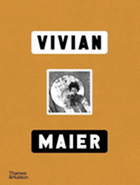
To learn all about Vivian Maier (1926-2009)--the great American street photographer whose work was unknown until its discovery two years before her death in her Chicago storage space--readers would do well to consult Ann Marks's Vivian Maier Developed: The Untold Story of the Photographer Nanny. And then, for those who want sheer retinal pleasure, there's Vivian Maier. As contributor Anne Morin puts it, the photographer "lingered on the residual moments in social life to which no one pays attention."
Vivian Maier groups more than 200 black-and-white and color photographs, most taken in the mid-1900s in New York and Chicago, into themed bundles: "Gestures," "Cinematic," "Childhood" and so on. In "Forms," a pair of work gloves on the ground resembles severed hands. "Streets" captures city kids and commuters, people reading newspapers and sailors and other men in uniform. Maier is a sort of Dorothea Lange of the city, her human subjects a racially and economically mixed bunch. When Maier's subjects occasionally signal their notice of her camera, they know better than to give her a fabricated smile--that's not what she's after.
A hallmark of Maier's work is the way it seems utterly bereft of the artist's ego. Is it a tragedy that her photographs were unknown until the tail end of her life? The section "Self-Portraits" would seem to suggest not. Maier tended to shoot herself in mirrors, looking away, in silhouette and otherwise collaborating with the apparent opinion of the world that she wasn't really there. --Nell Beram, author and freelance writer