

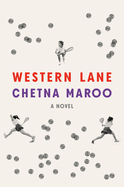
A slender yet potent family drama set in an unnamed English town, Chetna Maroo's Western Lane is the story of a girl driven to become an accomplished squash player by her father, who channels his grief over his wife's death into athletic ambitions for his daughters. The novel opens at the onset of a mild autumn, the unpredictable moods of classic British weather serving as an atmospheric backdrop for the young narrator as she emerges from the shadows of her family and finds herself occupying its pulsating center.
Eleven-year-old Gopi has recently lost her mother. Her teenage sisters, Mona and Khush, are as bereft as Gopi, but the three girls are relatively okay compared to their devastated father. Pa is a self-employed electrician who, in his despair, has lost sight of his children's needs. The only time he truly communicates with Gopi and her sisters is when they discuss squash techniques or practice drills at the local sports center, Western Lane, a decrepit place with peeling paint, a bar and a couple of barely used glass-backed squash courts. As the sisters become increasingly unmoored from their emotionally unavailable father, squash serves as the family's only common language.
British Indian author Maroo, winner of the 2022 Plimpton Prize for Fiction from the Paris Review, is a marvelous and restrained storyteller. The hypnotic gloom of Western Lane is undercut with subtle humor and an innocence that radiates from Gopi as she tries with heartbreaking sincerity to embrace the future her father has chosen for her. --Shahina Piyarali, reviewer