

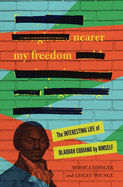
The Interesting Narrative of the Life of Olaudah Equiano, Or Gustavus Vassa, The African, published in 1789, is one of the earliest slave narratives. In Nearer My Freedom, Monica Edinger and Lesley Younge--former fourth grade co-teachers--brilliantly transform the autobiography into "found poems" by cutting and rearranging Equiano's original into verse: "Olaudah Equiano was an excellent writer, and using his autobiography as a source text helps preserve the eloquence of his voice while remixing it into poetry." Indeed, they open their adaptation with Equiano's searing address to the British Parliament in which he presents "the following genuine/ Narrative" in support of abolition.
"I was born/ and named Olaudah, signifying/ fortune and one favoured,/ having a loud voice,/ and well spoken." His idyllic childhood in the kingdom of Benin (now southern Nigeria) ended at age 11 when he was enslaved and transported to the Caribbean. He was sold and purchased multiple times (and given other names--"Jacob" he rejected, "Gustavus Vassa" he accepted when necessary), becoming an adept sailor under a Royal Navy lieutenant. After he eventually, miraculously bought his freedom, he landed in England where he used that loud, well-spoken voice as a notable abolitionist.
Throughout Equiano's narrative, the co-authors insert relevant history and context, such as Caribbean "Sugar Production" and "The Black Community in England." At book's end, they visually present the fascinating process of "Creating a Verse Version," parsing words and phrases directly from Equiano's prose. Further backmatter also includes a contextualizing timeline, glossary, extensive source notes and bibliography. Their deft transformation of Equiano's odyssey is well-equipped to inspire and empower new generations. --Terry Hong, BookDragon