

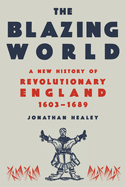
The political, religious, and social revolutions that raged across England in the 17th century still cast a smoldering glow upon today, claims historian Jonathan Healey in his superb study The Blazing World. In 1603, England was a land of (mostly) illiterate and poor farmers staving off starvation under the unchecked rule of a Scotsman, King James I. A "new world had arisen" by the century's end, one characterized by economic growth, higher literacy rates and wages, increased religious tolerance, and a robust parliamentary government. In between those bookends, says Healy, it was a story of "grubby politics," where "[p]opular petitioning, iconoclasm and mass protests" were a constant feature in a society roiled by civil war, army coups, religious dissent, and regicide. Healey's (The First Century of Welfare) erudition illuminates the clash of ideologies pitting Roundheads vs. Cavaliers in the English Civil War, King Charles I's sensational trial and execution at the hands of Parliament, Oliver Cromwell's Protectorate and the Glorious Revolution of 1688-9, to name just a few of the century's top notes.
But it is in the interstices where the "middling sort" of English society emerges in "vivid technicolour" through Healey's careful curation of ample source material. Healey admits there is "so much that is alien" about the 17th century, but the ways in which society grappled with "new forms of media, with a divisive culture war and with questions about who holds power" resonate today. The Blazing World achieves that rare balance between readability and incandescent scholarship. --Peggy Kurkowski, book reviewer and copywriter in Denver