

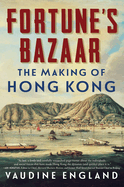
Fortune's Bazaar, a lively history of Hong Kong by journalist Vaudine England (The Quest of Noel Croucher), explores the diverse people who built the city into a multicultural world metropolis. Situated "bang central" in eastern Asia, Hong Kong's geography is as unique as its history: comprised of one main island (among 260 others) and the Kowloon Peninsula, it became a British Crown Colony in 1841 on the strength of its deep-sea harbor and nearness to the opium trade. The currents brought myriad people, ideas, and technologies to Hong Kong, where the "spoor" was dropped that helped make it "a place in between all others, but special in itself." Key to this transformation were the "in-between people" who facilitated trade as interpreters, bookkeepers, secretaries, and suppliers--the main agents of multicultural discourse and commerce.
Describing the rich "hybridity" of Hong Kong post-1841, England's study reads much like the "glorious mosaic" of the people who met, mixed, and made families beyond the marketplace: each chapter delivers vibrant vignettes of the opium traders, missionaries, intellectuals, and entrepreneurs who formed the fabric of Hong Kong well into the 20th century. The "energy and lubrication" Hong Kong brought to world trade is because of these "chameleons" who overstepped the limits of "class, colonial, or racial fencing" to build their own communities and, England argues, become "Hong Kongers." In a guarded coda, England reflects on Hong Kong's uncertain future under communist China's "ethno-nationalist" regime and what it may portend for this multicultural way station. Fortune's Bazaar is a meticulously researched yet deeply human portrait of those who bucked taboo to create a distinct community and a thriving Asian port city. --Peggy Kurkowski, book reviewer and copywriter in Denver