

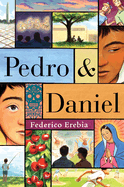
Federico Erebia's devastatingly beautiful debut, Pedro & Daniel, is based on the author's own relationship with his brother, and chronicles the lives of two gay Indigenous Mexican American brothers who grew up in 1970s Ohio and came into adulthood during the HIV and AIDS epidemic.
Erebia experiments with form in the novel. Part one, the protagonists' early lives, consists of 16 stories told in slightly differing third-person narration. Parts two through five use alternating first-person points of view, allowing Pedro and Daniel to tell their own stories. The third-person introductions depict brothers who, though born 15 months apart, are "son tal para cual" ("they are two of a kind"). They endure immense hardships, including food insecurity, and physical and emotional abuse at the hands of their mother, especially directed at their effeminate qualities. Pedro, who is dark skinned and has learning disabilities, withstands the bulk of his mother's abuse: "I bet I'm the embodiment of her shame." Parts two and three cover 1969 to 1980, each protagonist describing his own childhood, adolescence, and teen years. Part four and five illustrate the next 12 years: "1980 - Diagnosis" and "Diagnosis - 1992."
Throughout, the boys' close relationship is reflected in the Spanish proverbs (dichos) that Daniel invokes as a coping mechanism. "Desgracia compartida, menos sentida./ Shared misery is felt less." The result of Erebia's delicate work is a poetic YA novel that is both fiction and memoir. Julie Kwon's sweet grayscale mixed-media illustrations demarcate the book's five distinct sections and inject an air of hope and humor. --Kieran Slattery, freelance reviewer, teacher, co-creator of Gender Inclusive Classrooms