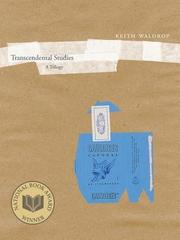
 Keith Waldrop, whose first poetry collection was a finalist for a National Book Award in 1969 and who won the prize 40 years later with his Transcendental Studies: A Trilogy, died July 27 at age 90. The New York Times called Waldrop "far more than a poet. He was a well-regarded translator of French poetry and prose, was an artist whose collages were exhibited in solo and group shows, and ran a small press with his wife, the poet Rosmarie Waldrop." He retired from Brown University as Brooke Russell Astor Professor of Literary Arts & Comparative Literature in 2011, after more than 40 years with the school.
In the 1960s, while pursuing his Ph.D. in Comparative Literature at the University of Michigan, Waldrop, with co-editors James Camp and D.C. Hope, founded Burning Deck, a literary journal. After four issues, it was transformed into a book press, with Camp and Hope departing and Rosmarie Waldrop joining as co-editor. The press ran from 1961 to 2017 and published more than 200 titles, with the majority of books after 1990 being book-length, perfect-bound offset editions, often including letter press flourishes on the covers or title pages.
In addition to dozens of books of his own poetry, he also collaborated with Rosmarie Waldrop on a series of poems, eventually collected as Well, Well, Reality, which Roubaud described as the work of a third Waldrop--one who could exist only when the couple composed together, where each often took liberties, using literary devices that might be thought of as "belonging to the other." Waldrop also published two books of prose, Hegel's Family and Light While There Is Light.
As a translator, Waldrop earned the rank of Chevalier of Arts and Letters from the French government. His translations ranged from canonical writers like Charles Baudelaire and Paul Verlaine to French contemporaries like Anne-Marie Albiach, Jean Grosjean, Jacques Roubaud, and Claude Royet-Journoud, Brown University noted.
Soon after he graduated, the University of Michigan published Waldrop's first collection, A Windmill Near Calvary (1968), which earned him his first National Book Award nomination. The second one, for Transcendental Studies in 2009, won the prize. Over the course of decades in between, Waldrop "honed an eye for the ironic, a seeming detachment that was infused with an emotional and intellectual undercurrent that could astonish the reader in its capacity to bridge disparate thought with, if not logic, then perhaps something deeper, richer," Brown University wrote. "Keith's self-effacement was deliberate--his sense of the line between the real and the unreal always ready for reassessment." Transcendental Studies is available from University of California Press.

