

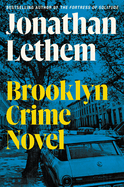
In Brooklyn Crime Novel, Jonathan Lethem (The Arrest) returns to the neighborhood of Boerum Hill, the setting for his novels Motherless Brooklyn and The Fortress of Solitude, and the place where he grew up in the 1970s. He discards conventional structure in favor of more than 100 brief passages that, taken together, paint a comprehensive, if decidedly idiosyncratic, social and economic portrait of his native borough over the half-century since his youth.
When it comes to the "crime" in the novel's title, Lethem concentrates on the broad subject of petty street theft that, in significant part, defines the interactions between the white teenagers who grow up on Boerum Hill's Dean Street and their Black counterparts in the neighborhood and nearby projects. All of this is acted out in something called "the dance"--shorthand for the nonviolent, but coerced, exchange of small amounts of cash between the more and less powerful. It's only in the novel's penultimate section, when a pair of shocking incidents leap the boundaries of this well-choreographed system, that the fundamental flaw in its logic is revealed.
Lethem's narrator hopscotches from one episode and time period to another, at first speaking from a detached position, but then gradually situating himself as more of a character in the story. Through the slow accretion of detail that clearly draws on Lethem's boyhood experiences, the novel becomes a sociological study of a neighborhood undergoing a tense transition, especially as gentrification and skyrocketing property values arrive when the "Brownstoner era" begins to emerge in the late 1970s. --Harvey Freedenberg, freelance reviewer