

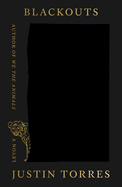
More than a decade after We the Animals, his debut novel, Justin Torres returns with Blackouts, an enigmatic and thought-provoking puzzle box of a novel about the limitations of historical accounts and narrative. An unnamed narrator arrives at a mysterious facility called merely "the Palace" to keep company with Juan Gay, a dying man he once knew, and begins telling stories to pass the darkening hours. But Juan has a story to tell in return: one about himself and about Jan Gay, a queer researcher whose lifelong work was co-opted by others. Based on a real book from the early 1940s, Sex Variants: A Study in Homosexual Patterns, the snippets of Jan's life and research become entangled in a larger portrait of stories left untold.
Torres's novel is a fragmentary tale, both in the way it's told and in its thematic resonances. What can be gleaned from the fragments of a life? What kinds of connections can be imagined in the gaps? As the narrator and Juan talk, their conversations become snippets of stories woven together with visual artifacts, much in the style of W.G. Sebald. Torres juxtaposes shards of narrative with photographs and documents, as well as censored documents that visualize the blacked-out gaps that define subversive stories. In this way, Blackouts engages in a precarious balancing act between fact and fiction, challenging readers' perceptions of what they understand to be history and what is constructed. Rather than offering any easy answers, Torres, like Juan, poses the important questions: "isn't that what mystery is? Your blackouts, these erasures? Frustration as art?" --Alice Martin, freelance writer and editor