

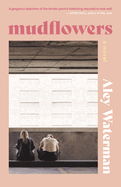
Aley Waterman's sensitive first novel, Mudflowers, follows a young woman exploring intimacy, biological and built families, and art. A love triangle twists and reshapes itself, with both trauma and revelation. "I wanted so badly to love in a good way," says Sophie, the protagonist and narrator, 27 years old and a Newfoundland native who recently moved to Toronto, where she lives with a misogynistic writer and her best friend since childhood. He is a beautiful man named Alex who is also her on-and-off lover. Sophie sees Maggie reading her poetry at an event and is immediately swept away. Maggie is talented and enigmatic, "with big eyes full of wide highways." The two become close friends and, sometimes, lovers.
Sophie creates glass mosaics for wealthy patrons, Maggie writes, and Alex works on indie films. They are young artists scraping together livings in a big city, taking drugs amid art events and the bar scene. They slide frankly and openly in and out of sexual relationships. Sophie obsesses over her mother's death. Alex's mother left when he was 12, their parallel losses an unspoken understanding. The addition of Maggie to their close relationship, forming a trio, acts as a magnetic force that both imbalances and strengthens the bond. Secrets surface, and the balance shifts again.
Mudflowers follows Sophie to an artist colony at a castle in France and eventually home to Newfoundland. Place is important to this thoughtful protagonist, who is given to contorted philosophic musings. "[W]as it how beauty was directed or how it was received that was most important?" she ponders. Mudflowers is thought-provoking, expansive, and raw. --Julia Kastner, librarian and blogger at pagesofjulia