

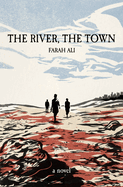
Farah Ali follows her lauded story collection, People Want to Live, with a first novel, The River, the Town, that shares similar aspects of spare, unblinking incisiveness. Moreover, it is delivered in three distinct voices covering three decades, with results not unlike reading interlinked short stories. These multiple perspectives form an intricate narrative, further complicated by unreliable characters.
In 1995, Baadal is a 15-year-old student growing up in the Town that "is considered part of the City." Their Town, however, is suffering: the River, its life source, was once "wide and deep" but has shrunk to "a thin stream flowing weakly over the ground." Hunger and heat are a daily provocation. The early death of his two younger sisters has made Baadal a disdained only child. His mother, Raheela, is "sharp and thin as a knife," and just as cutting; his father just turns away from her relentless abuses. Baadal finds solace away from home, first with his two closest buddies, and later with an older woman, Meena, who will eventually become his wife.
While Ali deftly builds her narrative arc around Baadal's challenging coming of age into troubled young adulthood, she also questions Baadal's experiences and memories in chapters that allow the two most important women in his life--Raheela and Meena--to speak.
Climate disasters threaten the globe. Communities can splinter anywhere. Families in crises are ubiquitous. In this teeming maelstrom of (in)humanity, Ali posits a wrenching, everyman tragedy that shrewdly reads as prophetic warning, nimbly cast in potent storytelling. --Terry Hong, BookDragon