

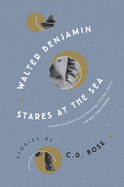
The title of the story "St. Augustine Checks His Twitter Feed" tells readers a good deal of what they need to know about the English writer C.D. Rose's collection Walter Benjamin Stares at the Sea. The story is a wry commentary on the allure of social media, as the cleric muses about writing what will become his Confessions and "oh, you know, the nature of suffering, evil, free will, time, the apocalypse, eternity, that kind of thing," while thinking about "changing his handle to @StAugustine_original," or wondering "why he hadn't gotten a blue checkmark."
Rose (Who's Who When Everyone Is Someone Else) gives a foretaste of much of what is to come in "Ognosia," the book's opener, which defies the short story convention of unity in point of view as it moves effortlessly among the perspectives of a group of characters in a hotel in an unnamed city. In "To Athens," Rose threads a lengthy sentence through a story whose paragraphs all begin with the phrase "I have a friend" to fashion an entrancing counterpoint. Meanwhile, "A Brief History of the Short Story" engagingly examines the form in its French, Russian, and American iterations through a smartly linked narrative.
Rose is heir to the tradition of short story writers like Jorge Luis Borges and Italo Calvino, and shares some of the sensibility of their contemporary counterparts like Steven Millhauser, Jim Shepard, and Aimee Bender. The 19 concise stories in this volume feature surrealist, metafictional and fabulist elements, and although not all succeed, there's much here that will appeal to readers who prefer short fiction of a less traditional variety. --Harvey Freedenberg, freelance reviewer