

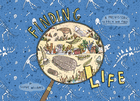
Sophie Williams (Map of You) invites readers to interact with prehistory in her eye-catching nonfiction children's picture book Finding Life. Each double-page spread summarizes one of Earth's epochs (from the late Precambrian Era through the Halocene) and challenges readers to find different creatures hidden in the detailed, art-filled depictions of each era. Budding scientists can learn plenty of facts while simultaneously practicing their observational skills in this enlightening exploration of life on Earth.
In each period, Williams introduces scientific terms, such as chordates in the Cambrian period (541-486 million years ago), tetrapods in the Devonian period (419-359 mya), and the K-Pg extinction in the Cretaceous period (145-66 mya). While this may be the first exposure to such terms for some readers, Williams presents them in accessible text that encourages valuable knowledge building about not only the creatures, but the planet itself. "During the Permian, almost all of the land on Earth came together to form one huge supercontinent called Pangea." Further strengthening this scientific foundation is the search-and-find activity on each page. Williams has hidden creatures (such as a Wiwaxia, a Parexus, and a Plesiosaurus) with various degrees of difficulty on land, under water, and in the air.
Finding Life concludes with a glossary that defines general terms and describes all the animals in the searches. This informative, engaging picture book for middle-grade readers may hook young audiences with an easy spot and encourage them to look longer at the striking images to unearth those animals which are more difficult to locate. Finding Life is a treasured literary find. --Jen Forbus, freelancer