

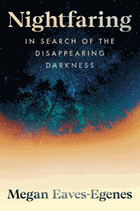
At a moment in which the glow of screens is rivaled only by the ever-present "skyglow" of municipal grids, the experience of a true night has become nearly a historical relic. In Nightfaring, Megan Eaves-Egenes takes readers on a restorative journey into the few remaining pockets of the planet where sundown still signals the appearance of stars. Her focus is the profound, creeping loss of the nocturnal world, a phenomenon often accepted as merely an aesthetic casualty of progress, but which she argues is a fundamental disruption to the nature of humanity. She presents light pollution as a sensory dazzling that has effectively desensitized people to their place in the cosmos, turning their gaze inward instead of out into the infinite.
As a former editor for Lonely Planet, Eaves-Egenes has a sensitive perspective that allows her to bridge the gap between the rural darkness of a lightless room at a monastery in Germany and the artificial twilights of our densest metropolises, like London, where only 10 out of thousands of stars might be visible on a clear night. Eaves-Egenes treats darkness as a physical substance, a presence with its own distinct textures, sounds, and even scents.
Like The End of Night by Paul Bogard, Eaves-Egenes's work explores the idea that humans have a biological and psychological right to darkness. Nightfaring will resonate for anyone affected by persistent light fatigue, as well as for the amateur astronomer and the environmentally interested looking for a fresh perspective on conservation. It's a call to reclaim rest, silence, and sense of scale in a world that refuses to turn off the lights. --Elizabeth DeNoma, executive editor, DeNoma Literary Services, Seattle, Wash.