

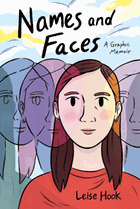
In the nine interlinked sections of her thought-provoking, poignant debut graphic memoir, Names and Faces, Leise Hook grapples with "what it means to have a mixed identity in a world that insists on its impossibility."
Hook beautifully marries the verbal and visual representation of her internal struggle, using predominant shadings of blue and salmon pink, with full-color renderings reserved for flashbacks or moments of clarity. In the introduction, she sets the stage for the tug-of-war within, a U.S.-born woman caught between her mother's Chinese heritage and her father's German roots. Her parents, both linguists, each gave her a name: Liang Li Dun in Chinese; Leise Sara Hook in English. A striking panel image in "Names" shows her portrait in triplicate, a red outline sketch and a blue outline sketch flanking a full-color rendering ("Leise and Lidun/ live alongside/ each other").
In "Fluency," Hook again uses a triple portrait image, this time in gray half-tones, to show a left profile speaking in English, the central image looking out at readers, and the right profile speaking in Chinese. Hook breaks her blue- and pink-dominated palette for full-color memories of elementary classmates in Michigan and of sixth grade at an international school in Tokyo. Hook begins the final section in a blue-tinted color scheme with a memory of sitting for a painter at age six, and ends with her own creation of a full-color self-portrait. Hook generously lays out the moving specifics of her journey, and thus allows readers to experience the universal, ongoing struggle to form a self. Her interrogation offers a template of the questions that make for a meaningful life. --Jennifer M. Brown