

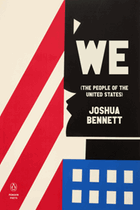
To hear Joshua Bennett's spoken-word poetry performed is to feel something erupt inside the structure and syllable of language. It is a conflagration, each line thrusting errant sparks into the air and threatening to ignite. That same energy and rhythm live in We (the People of the United States), a book-length work in two parts that searches for "the self not mine but ours," a line from A.R. Ammons in the epigraph.
The first section, "We," features a slim six poems about family, a familiar form of "we." In the first of two poems titled "We," Bennett writes of childhood efforts to "command the language// we inherited to live anew, or else/ fail magnificently at trying to say// what we held most dear, but could not/ yet sketch onto the palimpsest// of the world/ as we knew it." The book's second part uses Virgil's Georgics as its backbone; its ancient lines appear within Bennett's collection of 50 poems, one for each state of the United States. In "Decatur, Alabama," he describes how "the roll call of your children reads like the first/ ballot of blackness's hall of fame," and he dedicates "Talbot County, Maryland" to Frederick Douglass, who "spoke the images/ behind his eyes into colors we could carry & keep."
This stunning collection uplifts music and poetry, inventions and scientists, a collective sounding of light and life. And always, Bennett exalts the words and those who craft them, such as Zora Neale Hurston, "arms filled with pages// blank as bone, searching for the words we need/ but cannot hold and remain as we are." --Sara Beth West, freelance reviewer and librarian