

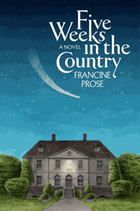
In June 1857, Hans Christian Andersen arrived at Gad's Hill, the country home of Charles Dickens. Unfortunately for the beloved Danish writer, what was to have been a chance to bask in the aura of one of his literary idols instead becomes a painfully awkward and overlong interlude for both men and the Dickens family. In Five Weeks in the Country, Francine Prose has brilliantly imagined this encounter between two giants of 19th-century literature in a story of friendship, professional ambition, and domestic conflict.
Andersen is a bundle of phobias and a hypochondriac, and he finds himself "hopelessly mute" around Dickens. The imperious Dickens writes incessantly to sustain his large household and to satisfy an adoring body of readers, while Andersen is afflicted with a catastrophic case of writer's block. A highlight of this well-drawn portrait of the burdens of artistic fame is the household's simmering tension as the Dickenses' marriage crumbles under the demands of parenting a brood and the writer's persistent flirtations with other women.
Prose skillfully relies on a Rashomon-like structure to describe Andersen's disastrous visit from three perspectives. The first is a collective account by the Dickens children, the second a third-person narrative from Dickens's point of view, while the last is an often deeply moving version in Andersen's voice. Five Weeks in the Country concludes with a lovely coda that deftly knits together several of the novel's plot strands. Anyone who has cherished the work of these literary masters will delight in Francine Prose's ability to bring them to life on the page in a novel that's the next best thing to reading their work. --Harvey Freedenberg, freelance reviewer