

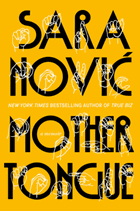
Mother Tongue, Sara Nović's fourth book, is a defiant memoir of parenthood achieved in spite of the troubled histories of deaf education, religious indoctrination, and international adoption.
Nović (True Biz) reports with amusement being asked if their sons are twins, though five-year-old S has fair skin while six-year-old K's is brown. Like Nović's partner, K was adopted from an overseas orphanage. And, like Nović, K is deaf, but was born so; Nović started going deaf at age 12, mostly managing to pass as hearing during middle and high school.
The touching story of their "motley family" alternates between personal and political realities. Alongside hearing loss, Nović experienced heart arrhythmia. They found a deaf community in college through attending a church that offered American Sign Language interpretation. However, conservative theology delayed acceptance of queerness for Nović and their first husband, who came out as gay in his mid-20s.
Attitudes toward deaf people and their education form a "sordid history": from Aristotle's equation of deafness with stupidity, through Alexander Graham Bell's eugenics, to disproportionate police violence against the disabled, including killings of deaf men of color. There have also been surprising enclaves of support, though, such as colonial Martha's Vineyard, where a high prevalence of deafness fostered tolerance. International adoption is an ethical minefield, but Nović is confident that K will recover from early language deprivation.
This is a fierce defense of deafness as a culture rather than a disability to be eradicated, and a beautiful exploration of the legacies of language and love. --Rebecca Foster, freelance reviewer, proofreader, and blogger at Bookish Beck