

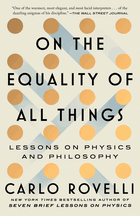
Theoretical physicist Carlo Rovelli (Seven Brief Lessons on Physics; The Order of Time) is known for his ability to elucidate obscure concepts that would normally be considered out of reach for those not trained in physics. On the Equality of All Things demonstrates this skill while also highlighting his willingness to embrace unconventional or even counterintuitive views. In exploring the strong links between the hard facts of science and the ambiguities of philosophical meditations, Rovelli maintains that both fields--physics and philosophy--have been at times trapped by limited perspectives.
Through a series of six lessons, Rovelli moves easily between accessible descriptions and complex mathematics. He admits that parts of the book may be "a bit more turbulent" than others, and gives readers full permission to just skip the densest material. These lessons focus on time and space, free will and existence, each one threaded with his theory of relational quantum mechanics and an argument against the search for one fundamental or foundational theory; instead, he argues for uncertainty and curiosity. He insists, "We need the nimble lightness of circularity, complexity, ambiguity, metaphors, emotions, the acceptance of uncertainty and change." Rovelli is a gentle teacher, guiding readers with patience and a quiet confidence that they will understand even "the most dizzying of the implications."
"Our entire life is full of surprises and discoveries. Science is no different," Rovelli writes, before reminding readers that "learning, changing our minds, is part of what we are." On the Equality of All Things offers a strong argument for remaining open to the mysterious and wondrous aspects of the world yet to be discovered. --Sara Beth West, freelance reviewer and librarian