


|
|
| photo: Leon Alesi | |
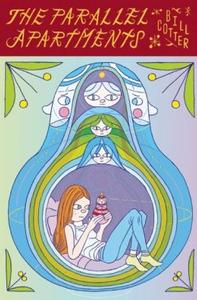
Bill Cotter is a rare book dealer in Austin, Tex. He was born in Dallas in 1964, and moved often before landing in Austin in 1997. He has spent a lot of time in psychiatric hospitals. He is the author of two works of fiction, Fever and the new The Parallel Apartments (McSweeney's, February 11, 2014). His short stories have appeared in the Paris Review, McSweeney's Quarterly, New Orleans Review and elsewhere. He won a Pushcart Prize for his essay "The Gentleman's Library," published in the Believer in June 2012. Cotter lives with the storyteller and performer Annie La Ganga.
On your nightstand now:
Dog of the South by Charles Portis, X'ed Out by Charles Burns, The Art Forger's Handbook by Eric Hebborn.
Favorite book when you were a child:
Hergé's The Calculus Affair. My family lived in Iran from '73-'76, and some of the only English books for children available at the international bookstores in Teheran and Ahwaz were the anesthetic fairytales and tedious mystery-adventure stories of the beloved and dumbfoundingly productive Englishwoman, Enid Blyton. I read many, many of these, and shibboleths of a para-British literary upbringing still occur in my syntax and grammar. It was after I swore off my last Blyton--The Book of Brownies--that I discovered Tintin. Even now, re-readings of The Calculus Affair soothe, startle and inspire.
Your top five authors:
Nadine Gordimer, José Saramago, A.M. Homes, Montaigne, Larry McMurtry.
Book you've faked reading:
Lord of the Rings by J.R.R. Tolkien. I've tried reading this, I have, but there's no greater readerly suppressant than a trilogy of flagstones that begins with the assumption that the reader has already worked his or her way through The Hobbit, another book I've lied about having read.
 Book you're an evangelist for:
The Oxford English Dictionary. Everyone should own or have access to this, either the shelf-splintering 20-volume edition (plus Additions, in three volumes), or the one-volume microprint edition (with flea-glass), or even the elegant online edition--the maturation, usage and meanings of 600,000 English words are nowhere more steeply examined than in this book, arguably mankind's greatest scholarly achievement (excepting, maybe, China's Yongle Encyclopedia). Just open it and start reading.
Book you've bought for the cover:
Pim and Francie by Al Columbia. I was attracted to the sinister ink-and-pencil, tape-masked cover drawing of two footloose, four-fingered cartoons that look to be on their way to inhabit somebody's nightmare. Come to find out it's worse than that. No graphic novel (nor any work of fiction, for that matter) has laid the creeping harrows on me like Pim and Francie did. The ruined landscape imagined by Columbia is verily Boschian in its horror, though even Bosch never rendered knives in such a ghastly manner.
Book that changed your life:
Montaigne's Essays. An "essay," as defined by high school English teachers everywhere, is a series of words organized to form a three- to five-page work of nonfiction in which the author's chosen subject is analyzed, interpreted or guessed at; this work is often presented to an instructor in essay-writing not as a written piece with intrinsic literary merit, but as an assertion of the author's understanding of and ability to commit an essay, which is then graded a C- and refunded to the author for revision. This process vests the high-school English student with a just loathing of essays, either the reading or the writing of them. Why I picked up Montaigne in my 30s I don't remember, but essays like "On Solitude," "How Our Mind Tangles Itself Up," "On Drunkeness," "On Books" and many others entirely subtracted my high-school notion of the genre, and in a way gave me permission to write.
Favorite line from a book:
"Come screeching up to the crosswalk, bucking and skidding with a bottle of rum in one hand and jamming the horn to drown out the music... glazed eyes insanely dilated behind tiny black, gold-rimmed greaser shades, screaming gibberish..., a genuinely dangerous drunk, reeking of ether and terminal psychosis." --Fear and Loathing in Las Vegas by Hunter S. Thompson
Book you most want to read again for the first time:
Blindness by José Saramago.
Books you wish you could unread and have back the hours lost on them:
The Da Vinci Code by Dan Brown; Ulysses by James Joyce; The Satanic Verses by Salman Rushdie; Star: A Novel by Pamela Anderson.