

 Few of today's great American poets are also very religious. Mary Karr comes to mind, who converted to Catholicism in her 40s. Another is Christian Wiman. Wiman, like Karr, is a Texan. Raised as a Southern Baptist, he lost his religion early on, then wrote several fine books of poetry, became editor of Poetry magazine and learned he had a rare, incurable form of cancer. As he described in his popular memoir, My Bright Abyss, he returned to faith, to prayer. He felt his strong spiritual hunger fulfilled--and his cancer hasn't killed him yet.
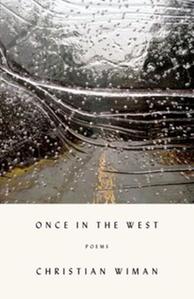
In his fourth poetry collection, Once in the West, Wiman explores the "hard horizonless country" of his West Texas roots, his religion, his family and the joy of being alive. Here, he proves himself to be a writer who can show us the world poetically from a metaphysical, mystical, religious viewpoint. His poetry can sustain, lift up, support--it is sustenance for the soul. The opening poem, "Prayer," is an invocation to the reader: "my prayer/ is that a mind/ blurred/ by anxiety/ or despair/ might find/ here/ a trace/ of peace."
His is an intense, intimate poetry, employing surprising meter, rhyme and word juxtaposition to share ideas, opinions and memories, as he does in "Keynote": "I saw/ I saw/ like a huge claw time tear through the iron/ armory and the baseball fields/ the slush-puppy stand/ the little pier at Towle Park Pond/ until I stood strangered/ before the living staring Godfearing men/ who knew me when." Or in "Razing a Tower": "Once in the west I rose to witness/ the cleverest devastation./ It was early but I was late/ and the quiet into which I crept... was intimate, inviolate, tribal./ I didn't so much keep it as was kept."
In "Winterlude," he confesses to the reader his experience with cancer, the pain and the suffering. "Painlady leaning into pain as every day she does:/ this time it's mine, this time my spine's/ rivering new forms of formlessness:/ lava crawling creaturely through my jaw,/ one shoulder shot through with shineless light/ only the unliving could see by."
In an epigraph to "Self-Portrait, with Preacher, Pain, and Snow," Wiman quotes theologian Karl Barth. It does much to encapsulate Wiman's life and art: "We need to be ready and resolved simply to let the truth be told us and therefore to be apprehended by it." --Tom Lavoie, former publisher
Shelf Talker: Wiman's poetry shows us how to experience and confront the fear of death, and the sustenance of a faith in something greater.