

This is the latest installment in our series examining how independent booksellers in Seattle, Wash., have adjusted to the city's rising minimum wage; see previous articles here.
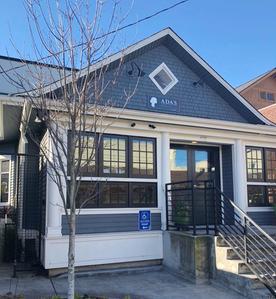 When Danielle Hulton and her husband, David Hulton, started Ada's Technical Books & Cafe in 2010, they were newcomers to the world of bookselling. Both had a background in technology, specifically electrical and computer engineering, and for the first few years the store was entirely a bookstore, one that Hulton said she's always described as a "general bookstore that specializes in science and technology."
In 2012, around the time that the store's original lease was up, Hulton came to the realization that diversifying the business would make it a much more stable year-round venture. Hulton and her team took the opportunity of moving into a new storefront to add a cafe and coffee shop and, eventually, co-working and events spaces. Despite having so many facets to the business, Ada's has only two types of staff, which Hulton referred to as front-of-house and back-of-house. Employees with culinary experience and who work in the kitchen are back-of-house, while everyone else is front-of-house; they do everything from serving coffee to selling and shelving books.
 "We used to have two different starting wages," recalled Hulton. "One for front-of-house, one for back-of-house. It was a very complicated system." Until 2017, Ada's accepted tips, the majority of which went to front-of-house employees. As a result, back-of-house staff had a higher starting wage. But of their own volition, front-of-house employees decided to give a small percentage of their tips to back-of-house staff in the sake of fairness. Front-of-house staff actually wrote a contract to that effect, which new employees had to read and sign when they joined the staff.
For the first few years after the minimum wage law came into effect, the fact that Ada's accepted tips actually gave the store a bit of a cushion, in that it put them on the slowest mandated schedule. Despite that cushion, Hulton and her general manager ultimately decided to stop accepting tips because the system was "confusing to customers, confusing to staff and not fair to everybody." It also didn't help, Hulton added, that there was a lot of "weird legal stuff around tips."
 With tips no longer accepted, there is now a single starting wage for all new staff, whether they're front-of-house or back-of-house. Before this decision came into effect, Hulton and her general manager pulled every employee's pay checks, estimated what they would all be making, including tips, and added about 10 cents per hour, to ensure that no one would be making less because of the lack of tips. Remarked Hulton: "We did that for the whole staff."
Perhaps the single greatest effect that the minimum wage increase has had on Ada's has pertained to staffing. As a result of the rising wage, Hulton has had to employ a leaner staffing model than she would prefer. In particular, she said, the store recently came off of a schedule that Hulton realized was "way overstaffed" in terms of front-of-house employees.
"That was the hardest realization that I've had in the last nine years," said Hulton. "We have this really stable staff of amazing people, but we can't afford everybody."
While that realization and its repercussions have been difficult, Hulton said that thanks to having such a stable staff she's been able to be "really honest" explaining what the company can afford. She noted that she's always found it "easy to overstaff," and reining that in is something she continues to work on as far as business management is concerned.
Hulton said that in general, she is very supportive of a higher minimum wage, and she feels strongly that people should be able to make careers out of bookselling or being a barista or being a chef. But while supportive of higher wages generally, she was concerned from a business standpoint about the minimum wage law's implementation. One of the clearest ways to help offset the increased payroll costs is to raise prices on things like food, drinks and non-book products, which to Hulton has always seemed slightly counter-intuitive. "We're raising the minimum wage so staff at places like Ada's could afford to shop at places like Ada's," she said. "But with raising prices, that's not happening."
Discussing her background in engineering, Hulton noted that it is a very different industry in terms of benefits and pay rates, even at the small engineering firm she worked at before founding Ada's. She's tried to provide her employees at Ada's with similar benefits, including health insurance for full-time employees, paid parental leave and subsidizing her staff's transit cards, but as costs continue to rise, those may be in jeopardy. "That is one thing that's a concern," she said. "We want to provide those but we're really fighting to be able to afford it."
Seattle as a whole, Hulton continued, is "really struggling" with the explosive growth it's seen over the past decade. She said she still feels that there may have been a better way to try to attain a livable wage, but it was nevertheless good to have a phase-in period. She noted, though, that with the wage increase, "it wasn't like we just solved this problem." --Alex Mutter