


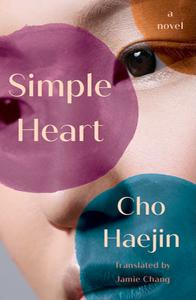
 Known for highlighting the experiences of the marginalized, Korean novelist Cho Haejin deftly navigates the complex emotions surrounding identity and place through Nana, adopted by French parents after being found on the tracks at a railway station in Seoul. Translated from the Korean by Jamie Chang, Simple Heart is confident and clear, employing a direct, almost detached, tone that belies its deeply felt core.
A respected playwright, Nana is forced to reconcile her ambivalence about motherhood with the fact of her unplanned pregnancy. She struggles against a rising tide of uncertainty and even despair over the feelings of abandonment that resurface from her childhood. Back in Korea to film a documentary about her experience as a foreign adoptee, Nana allows herself to probe those earliest wounds, memories washing in where previously she kept them safely at bay: "Instantly, a volume dial somewhere on the border between memory and oblivion was turned up, and a few scenes from the past rang out 'aga' like bells."
Nana explains that an e-mail from the film's director arrived on the same day she first began thinking of her unborn child as "Wooju" (Korean for universe), the day she realized, "From now on, I must remember every moment. I am the intermediary between Wooju and the world, the harbinger of their existence to the people of this world, and witness-bound to testify to their process of growing up." Seoyeong, the director, drew Nana in by referring to the name she was given by the train conductor who rescued her from the tracks and fostered her for a short while: Munju.
Already alert to the importance of names, Seoyeong awakens Nana's attention by explaining that "our names are a kind of house where our identity or sense of self reside. People forget everything so quickly here. I truly believe that remembering a name is how we pay our respects to the forgotten worlds." It is this invitation to remember that Nana/Munju responds to, a promise that is fulfilled as she meets people who help her see herself and her possible future as a mother in a new light. Readers will grieve and hope with Nana as pieces of her past and a new understanding of what it means to love and be loved are revealed to her. Perfect for anyone who has ever wondered what their life might have been like under different circumstances, Simple Heart is full of heart and anything but simple. --Sara Beth West, freelance reviewer and librarian
Shelf Talker: Exploring the complex emotions surrounding foreign adoption, identity, and motherhood, Korean novelist Cho Haejin's Simple Heart is clear-eyed and full of depth.