

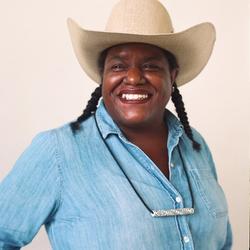
Poet and novelist DéLana R.A. Dameron, "whose work spoke with aching honesty about the Black experience in the modern South, and who moonlighted as a competitive horsewoman from her farm in South Carolina," died on November 29, the New York Times reported. She was 40.
 |
|
| DéLana R.A. Dameron | |
Dameron's debut poetry collection, How God Ends Us (2009), won the South Carolina Poetry Book Prize. Redwood Court (2024), her first book of prose, is a collection of linked stories. Novelist Charmaine Wilkerson praised the author for doing "a beautiful job weaving in local vernacular and casting a fresh gaze on an engaging, though flawed, cast of characters." Reese Witherspoon selected Redwood Court for her book club.
Dameron intended those books, as well as another volume of poetry, Weary Kingdom (2017), "to be the start of a 10-book cycle exploring everyday Black life in and around Columbia, her hometown," the Times noted, adding that she drew inspiration from playwright August Wilson's 10-play cycle set in different decades of the 20th century.
"She was a world builder," said Maya Millett, her editor at Random House,
Dameron "wanted her cycle to encompass a variety of forms: poetry, novels, even children's literature. (She wrote a picture book about her horse Shadrach, which is currently in production.)," the Times noted.
"I believe my project as a writer who is also Black and Southern is to document the experience of Black, Southern folks across multiple generations," she said in an interview last year with the website Indyweek.
Dameron returned to South Carolina in 2019 after 13 years in New York City. She started taking riding lessons, and, with her husband, Curtis John, purchased a farm, Saloma Acres, outside Columbia in 2021. Within a few years she was riding competitively. She also made the farm "a public space, hosting events like theater productions and movie nights. Among the cultural groups she brought to the farm was the Luminal Theater, an organization, run by Mr. John, which shows Black-made independent films on a screen assembled in a field," the Times wrote.
"Her intention was to make sure that Black people felt comfortable in nature and were connected to the land," said Renée Watson, a writer and friend. "She was very good at gathering folks and making sure that everyone felt welcomed."
From her poem "When Mama died, I lost my air":
When Mama died, I lost my air. Hit with an anvil of grief.
In dreams, the rains came. Streets filled with sorrow.
I'm standing with Thomas at the bridge edge seeking relief.
The sound of her voice is fleeting. Time is a thief--
she will never return to me. Thomas says not to follow
his lead. Don't hold onto it. It's heavy. This anvil of grief.